Understanding Numbers
From Sinai’s ordered camp to a new generation at the edge of the land.
14 sections · selected Scripture available offline · private notes · review questions
A People in the Wilderness
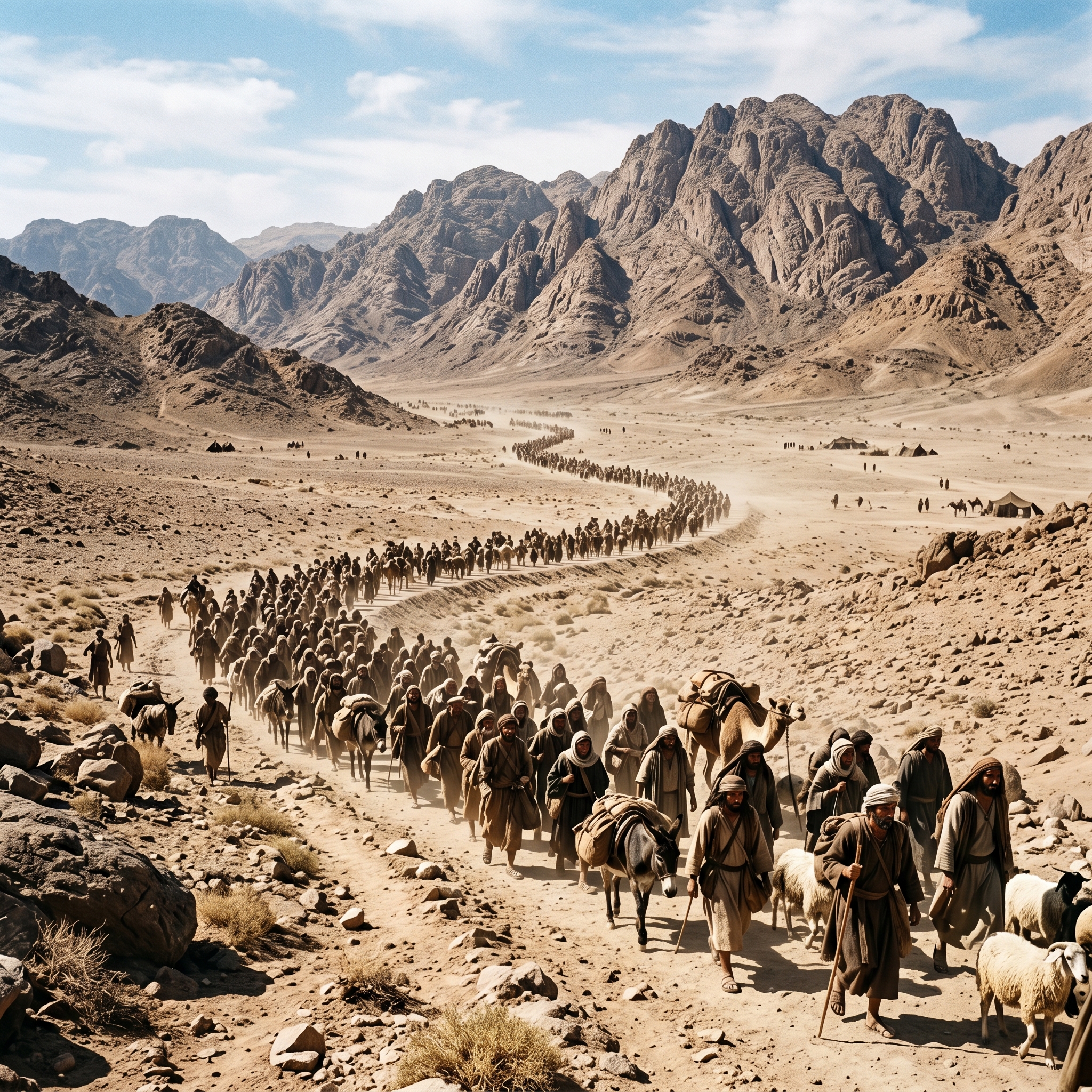
Numbers tells what happened between the rescue from Egypt and Israel’s entry into Canaan. It opens at Sinai, after the exodus and the building of the tabernacle, and closes on the plains of Moab opposite Jericho. Its censuses matter, but its larger question is whether a redeemed people will trust the God who dwells among them. One generation refuses to enter; another prepares to inherit. Narrative and law work together to explain life with a holy and faithful God.
At Sinai: count, arrange, consecrate and prepare.
On the move: guidance, provision and complaints.
At the turning point: spies, fear and refusal to enter.
Through the wilderness years: rebellion, priesthood and cleansing.
Toward Moab: loss, conflict, blessing and another rebellion.
A new census: inheritance, leadership and preparation.
Open each Scripture panel for the included passages. Notes, review answers and completion marks save on this device when storage is available. Export your notes for a personal backup. Full-chapter links require internet access.
Where Numbers fits
Genesis introduces the family and promises; Exodus recounts rescue and covenant; Leviticus explains holy worship and life; Numbers follows the people through the wilderness; Deuteronomy addresses the generation preparing to enter the land. Numbers begins in the second year after leaving Egypt, at Sinai’s tent of meeting. The people depart Sinai in chapter 10 and ultimately reach Moab, east of the Jordan. They do not cross the Jordan in Numbers. Deuteronomy and then Joshua carry the story forward. This placement prevents the book from becoming a disconnected collection of strange incidents and census totals.
Egypt is behind them; Canaan is before them; the wilderness tests how they will live between rescue and inheritance.
1 Yahweh spoke to Moses in the wilderness of Sinai, in the Tent of Meeting, on the first day of the second month, in the second year after they had come out of the land of Egypt, saying,
11 In the second year, in the second month, on the twentieth day of the month, the cloud was taken up from over the tabernacle of the covenant. 12 The children of Israel went forward on their journeys out of the wilderness of Sinai; and the cloud stayed in the wilderness of Paran. 13 They first went forward according to the commandment of Yahweh by Moses.
13 These are the commandments and the ordinances which Yahweh commanded by Moses to the children of Israel in the plains of Moab by the Jordan at Jericho.
Why the book is called Numbers
The English title reflects the major censuses near the beginning and end. The Hebrew name is commonly rendered ‘In the wilderness,’ drawing on the opening wording. Both titles help. The first census counts men twenty years old and upward able to go to war; the Levites are counted separately for their service. It is not a count of every Israelite. The second major census prepares a new generation for land allotment after the wilderness judgments. Numbers gives 603,550 in the first military census and 601,730 in the second. Read the stated totals accurately while recognizing that the meaning of ancient numbering terms and the demographic scale are discussed by interpreters.
Two counts frame a generational transition, not merely an interest in statistics.
2 “Take a census of all the congregation of the children of Israel, by their families, by their fathers’ houses, according to the number of the names, every male, one by one, 3 from twenty years old and upward, all who are able to go out to war in Israel. You and Aaron shall count them by their divisions.
45 So all those who were counted of the children of Israel by their fathers’ houses, from twenty years old and upward, all who were able to go out to war in Israel— 46 all those who were counted were six hundred three thousand five hundred fifty. 47 But the Levites after the tribe of their fathers were not counted among them.
51 These are those who were counted of the children of Israel, six hundred one thousand seven hundred thirty. 52 Yahweh spoke to Moses, saying, 53 “To these the land shall be divided for an inheritance according to the number of names. 54 To the more you shall give the more inheritance, and to the fewer you shall give the less inheritance. To everyone according to those who were counted of him shall his inheritance be given. 55 Notwithstanding, the land shall be divided by lot. According to the names of the tribes of their fathers they shall inherit. 56 According to the lot shall their inheritance be divided between the more and the fewer.”
The camp has a center
The tribes are arranged around the tent of meeting, with the Levites assigned responsibilities around it. Movement, worship and service are ordered in relation to God’s dwelling. The camp is not simply an army organized for efficiency: its central reality is Yahweh’s presence. Different Levitical families have different duties, and the holy objects are handled with care. The holiness regulations of chapter 5 underline the seriousness of the divine presence. Their ancient categories should not be used to shame people with illnesses or disabilities today. The text’s own explanation is the preservation of a camp in whose midst God dwells.
The arrangement teaches through space: God’s presence belongs at the center of communal life.
1 Yahweh spoke to Moses and to Aaron, saying, 2 “The children of Israel shall encamp every man by his own standard, with the banners of their fathers’ houses. They shall encamp around the Tent of Meeting at a distance from it.
3 You shall put both male and female outside of the camp so that they don’t defile their camp, in the midst of which I dwell.”
Consecration, blessing and participation
These chapters address restitution, marital suspicion, Nazirite dedication, priestly blessing, offerings and Levitical service. Some practices are unfamiliar and difficult; careful reading should distinguish the text’s regulation from modern assumptions about it. The Nazirite vow offered a defined form of dedication involving abstention and ritual boundaries. The priestly blessing in chapter 6 makes the desired end of covenant life vivid: divine keeping, favor and peace. Chapter 7’s repeated tribal offerings give each tribe a place in the shared worship rather than treating repetition as wasted space. Chapter 8 sets apart Levites for the tent’s service. Ordered worship involves both communal participation and particular responsibilities.
The book combines boundaries with blessing; holiness is not reducible to punishment.
24 ‘Yahweh bless you, and keep you. 25 Yahweh make his face to shine on you, and be gracious to you. 26 Yahweh lift up his face toward you, and give you peace.’ 27 “So they shall put my name on the children of Israel; and I will bless them.”
14 Thus you shall separate the Levites from among the children of Israel, and the Levites shall be mine. 15 “After that, the Levites shall go in to do the service of the Tent of Meeting. You shall cleanse them, and offer them as a wave offering. 16 For they are wholly given to me from among the children of Israel; instead of all who open the womb, even the firstborn of all the children of Israel, I have taken them to me.
Learning when to move and when to stay
Israel celebrates Passover, remembering the rescue that precedes the journey. A provision for those unclean through contact with a dead body or away on a journey shows that a difficulty can be addressed by seeking instruction rather than simply excluding people without remedy. The cloud over the tabernacle governs departures and encampments. Trumpets summon the congregation and signal movement. Numbers then gives the departure from Sinai and the order of march. Guidance includes waiting as well as going. These passages describe Israel’s particular wilderness guidance; they are not a promise that every modern decision will be answered by an equally visible sign.
Passover remembers where they came from; the cloud governs where they go next.
17 Whenever the cloud was taken up from over the Tent, then after that the children of Israel traveled; and in the place where the cloud remained, there the children of Israel encamped. 18 At the commandment of Yahweh, the children of Israel traveled, and at the commandment of Yahweh they encamped. As long as the cloud remained on the tabernacle they remained encamped.
22 Whether it was two days, or a month, or a year that the cloud stayed on the tabernacle, remaining on it, the children of Israel remained encamped, and didn’t travel; but when it was taken up, they traveled. 23 At the commandment of Yahweh they encamped, and at the commandment of Yahweh they traveled. They kept Yahweh’s command, at the commandment of Yahweh by Moses.
Complaint, provision and leadership strain
The journey soon exposes discontent. The people crave the foods of Egypt and despise the manna; Moses, overwhelmed by the burden, speaks honestly to God. Seventy elders share responsibility, and the quail episode combines provision with judgment on consuming craving. In chapter 12 Miriam and Aaron speak against Moses, and the dispute touches his unique prophetic role. Miriam’s exclusion is followed by intercession and restoration, and the camp waits for her. These chapters should not be flattened into a rule that questioning leaders is always wrong: Moses himself laments, and the narrative assesses particular motives, claims and actions. The leader is neither self-sufficient nor beyond the need for God’s help.
Honest need and contemptuous rejection are not the same response to hardship.
14 I am not able to bear all this people alone, because it is too heavy for me. 15 If you treat me this way, please kill me right now, if I have found favor in your sight; and don’t let me see my wretchedness.” 16 Yahweh said to Moses, “Gather to me seventy men of the elders of Israel, whom you know to be the elders of the people and officers over them; and bring them to the Tent of Meeting, that they may stand there with you. 17 I will come down and talk with you there. I will take of the Spirit which is on you, and will put it on them; and they shall bear the burden of the people with you, that you don’t bear it yourself alone.
13 Moses cried to Yahweh, saying, “Heal her, God, I beg you!” 14 Yahweh said to Moses, “If her father had but spit in her face, shouldn’t she be ashamed seven days? Let her be shut up outside of the camp seven days, and after that she shall be brought in again.” 15 Miriam was shut up outside of the camp seven days, and the people didn’t travel until Miriam was brought in again.
The turning point: the spies and the refusal
Twelve men explore Canaan and return with evidence of its fruitfulness. The disagreement is over what the obstacles mean. Caleb urges action; the fearful report spreads, and the congregation proposes returning to Egypt. Joshua and Caleb appeal to Yahweh’s presence and promise. Moses intercedes when judgment is announced. The consequence is that the counted adult generation will not enter, with Joshua and Caleb named as exceptions. The forty days of exploration are linked to forty years in the wilderness. A later attempt to go up without Yahweh’s presence fails. Belated action on one’s own terms is not the same as trusting obedience.
The decisive delay comes from refusal to trust, not because the geographical distance required forty years.
6 Joshua the son of Nun and Caleb the son of Jephunneh, who were of those who spied out the land, tore their clothes. 7 They spoke to all the congregation of the children of Israel, saying, “The land, which we passed through to spy it out, is an exceedingly good land. 8 If Yahweh delights in us, then he will bring us into this land, and give it to us: a land which flows with milk and honey. 9 Only don’t rebel against Yahweh, neither fear the people of the land; for they are bread for us. Their defense is removed from over them, and Yahweh is with us. Don’t fear them.”
29 Your dead bodies shall fall in this wilderness; and all who were counted of you, according to your whole number, from twenty years old and upward, who have complained against me, 30 surely you shall not come into the land concerning which I swore that I would make you dwell therein, except Caleb the son of Jephunneh, and Joshua the son of Nun. 31 But I will bring in your little ones that you said should be captured or killed, and they shall know the land which you have rejected. 32 But as for you, your dead bodies shall fall in this wilderness. 33 Your children shall be wanderers in the wilderness forty years, and shall bear your prostitution, until your dead bodies are consumed in the wilderness. 34 After the number of the days in which you spied out the land, even forty days, for every day a year, you will bear your iniquities, even forty years, and you will know my alienation.’
Wilderness years: law and rebellion together
After the refusal, chapter 15 speaks about offerings ‘when’ the people enter the land. The placement matters: judgment has not erased the promise. The chapter distinguishes unintentional sin from defiant rejection and includes the Sabbath-breaker and tassels as a reminder to obey. Korah’s rebellion and the resistance associated with Dathan and Abiram then challenge the appointed order. Severe judgment follows, and Aaron stands with incense between the dead and living during a plague. His budding staff confirms his priestly role. These events are specific claims about Israel’s covenant order, not a license for leaders today to threaten every critic with Korah’s fate.
Even amid judgment, instruction for future life in the land keeps the promise in view.
1 Yahweh spoke to Moses, saying, 2 “Speak to the children of Israel, and tell them, ‘When you have come into the land of your habitations, which I give to you, 3 and will make an offering by fire to Yahweh—a burnt offering, or a sacrifice, to accomplish a vow, or as a free will offering, or in your set feasts, to make a pleasant aroma to Yahweh, of the herd, or of the flock—
8 On the next day, Moses went into the Tent of the Testimony; and behold, Aaron’s rod for the house of Levi had sprouted, budded, produced blossoms, and bore ripe almonds. 9 Moses brought out all the rods from before Yahweh to all the children of Israel. They looked, and each man took his rod. 10 Yahweh said to Moses, “Put back the rod of Aaron before the covenant, to be kept for a token against the children of rebellion; that you may make an end of their complaining against me, that they not die.”
Priesthood, cleansing and dependence
God clarifies priestly and Levitical responsibilities, provision and accountability. The Levites receive support for service rather than a tribal inheritance like the others; priests and Levites are not interchangeable categories. The red-heifer rite in chapter 19 addresses defilement through contact with death. Such ritual impurity is not identical to personal moral guilt: handling a death may be a necessary family responsibility. The community nevertheless needs a way of cleansing to continue life around the sanctuary. These detailed provisions show that living with death in the wilderness and living near holy presence require attention, mediation and restoration. Read their ritual logic before reaching for later theological parallels.
Ritual impurity and moral wrongdoing must not be treated as synonyms.
20 Yahweh said to Aaron, “You shall have no inheritance in their land, neither shall you have any portion among them. I am your portion and your inheritance among the children of Israel. 21 “To the children of Levi, behold, I have given all the tithe in Israel for an inheritance, in return for their service which they serve, even the service of the Tent of Meeting.
11 “He who touches the dead body of any man shall be unclean seven days. 12 He shall purify himself with water on the third day, and on the seventh day he shall be clean; but if he doesn’t purify himself the third day, then the seventh day he shall not be clean.
Loss, water and a changed route
Miriam dies at Kadesh. When the people lack water, Moses and Aaron fail to honor God as commanded; Moses strikes the rock, and both are told they will not bring the assembly into the land. Edom refuses passage, forcing a detour. Aaron dies on Mount Hor, and Eleazar receives his priestly garments. In chapter 21 poisonous serpents follow another rebellion; those bitten look at the bronze serpent as instructed and live. Israel also defeats Sihon and Og and moves toward Moab. These chapters mark loss of familiar leaders alongside continued divine provision. Their events are not evenly distributed travel diary entries, so avoid pretending every wilderness year has been narrated in equal detail.
The journey continues, but even major leaders remain accountable.
10 Moses and Aaron gathered the assembly together before the rock, and he said to them, “Hear now, you rebels! Shall we bring water out of this rock for you?” 11 Moses lifted up his hand, and struck the rock with his rod twice, and water came out abundantly. The congregation and their livestock drank. 12 Yahweh said to Moses and Aaron, “Because you didn’t believe in me, to sanctify me in the eyes of the children of Israel, therefore you shall not bring this assembly into the land which I have given them.”
8 Yahweh said to Moses, “Make a venomous snake, and set it on a pole. It shall happen that everyone who is bitten, when he sees it, shall live.” 9 Moses made a serpent of bronze, and set it on the pole. If a serpent had bitten any man, when he looked at the serpent of bronze, he lived.
Balaam: blessing from outside, failure within
Balak, king of Moab, fears Israel and summons Balaam to curse them. The donkey episode exposes Balaam’s lack of perception. Despite Balak’s pressure, the oracles announce blessing rather than the requested curse. God’s purpose cannot simply be purchased or manipulated. The next chapter is therefore a striking contrast: at Peor, Israelites participate in sexual wrongdoing and idolatrous worship, and judgment follows. External attempts to curse do not undo the promise, but internal unfaithfulness is still devastating. Later Numbers 31:16 links Balaam with the counsel behind the Peor offense. Reading these chapters together gives a clearer picture than treating the talking donkey as an isolated children’s story.
Protection from an external curse does not remove the community’s responsibility for fidelity.
19 God is not a man, that he should lie, nor a son of man, that he should repent. Has he said, and he won’t do it? Or has he spoken, and he won’t make it good? 20 Behold, I have received a command to bless. He has blessed, and I can’t reverse it.
1 Israel stayed in Shittim; and the people began to play the prostitute with the daughters of Moab; 2 for they called the people to the sacrifices of their gods. The people ate and bowed down to their gods. 3 Israel joined himself to Baal Peor, and Yahweh’s anger burned against Israel.
A new generation receives responsibility
The second census identifies the generation preparing for inheritance. The daughters of Zelophehad bring a claim concerning their father’s portion, and God affirms their case, leading to an inheritance ruling. Moses is shown the land he will not enter and asks for a successor so the congregation will not be like sheep without a shepherd. Joshua is commissioned publicly, but Moses’ unique role is not simply reproduced without distinction. Calendars of offerings and regulations concerning vows place worship and accountable speech alongside land and leadership. Preparation for the future includes arrangements for those who might otherwise be left without an inheritance, not only military organization.
The new generation receives both a promise and concrete responsibilities.
6 Yahweh spoke to Moses, saying, 7 “The daughters of Zelophehad speak right. You shall surely give them a possession of an inheritance among their father’s brothers. You shall cause the inheritance of their father to pass to them. 8 You shall speak to the children of Israel, saying, ‘If a man dies, and has no son, then you shall cause his inheritance to pass to his daughter.
15 Moses spoke to Yahweh, saying, 16 “Let Yahweh, the God of the spirits of all flesh, appoint a man over the congregation, 17 who may go out before them, and who may come in before them, and who may lead them out, and who may bring them in, that the congregation of Yahweh may not be as sheep which have no shepherd.” 18 Yahweh said to Moses, “Take Joshua the son of Nun, a man in whom is the Spirit, and lay your hand on him. 19 Set him before Eleazar the priest, and before all the congregation; and commission him in their sight. 20 You shall give authority to him, that all the congregation of the children of Israel may obey.
Land, justice and the difficult ending
The Midianite war in chapter 31 includes severe violence; the text connects it with Peor, but that narrative rationale does not make it a general model for private action or modern warfare. Reuben, Gad and half-Manasseh receive land east of the Jordan with obligations to help the others. Chapter 33 reviews stages of the journey, chapter 34 addresses boundaries, and chapter 35 provides Levitical towns and cities of refuge. Refuge distinguishes unintentional killing from murder and requires communal judgment rather than unrestrained revenge. Chapter 36 returns to Zelophehad’s daughters and preservation of tribal inheritance. Numbers ends with laws in Moab, looking ahead to life in the land; arrival remains future.
The closing chapters connect inheritance with shared obligation, worship and the protection of justice.
20 Moses said to them: “If you will do this thing, if you will arm yourselves to go before Yahweh to the war, 21 and every one of your armed men will pass over the Jordan before Yahweh until he has driven out his enemies from before him, 22 and the land is subdued before Yahweh; then afterward you shall return, and be clear of obligation to Yahweh and to Israel. Then this land shall be your possession before Yahweh. 23 “But if you will not do so, behold, you have sinned against Yahweh; and be sure your sin will find you out.
11 then you shall appoint for yourselves cities to be cities of refuge for you, that the man slayer who kills any person unwittingly may flee there. 12 The cities shall be for your refuge from the avenger, that the man slayer not die until he stands before the congregation for judgment.
13 These are the commandments and the ordinances which Yahweh commanded by Moses to the children of Israel in the plains of Moab by the Jordan at Jericho.
What to carry away from Numbers
Numbers is the story of a people organized around God’s presence, repeatedly failing to trust, yet preserved for a future they did not create. Its structure moves from one counted generation to another, from Sinai to Moab, from preparation through refusal to renewed preparation. Read narrative and law together: both concern how this people can live with a holy God. Later Scripture reflects on the wilderness as a warning and a call to faithful trust, for example Psalm 95, 1 Corinthians 10 and Hebrews 3–4. Those later uses should be read in their own contexts rather than pasted over every detail. The book’s ending asks the reader to look forward with both hope and sobriety.
Remember three words: presence, trust, preparation.
63 These are those who were counted by Moses and Eleazar the priest, who counted the children of Israel in the plains of Moab by the Jordan at Jericho. 64 But among these there was not a man of them who were counted by Moses and Aaron the priest, who counted the children of Israel in the wilderness of Sinai. 65 For Yahweh had said of them, “They shall surely die in the wilderness.” There was not a man left of them, except Caleb the son of Jephunneh, and Joshua the son of Nun.
20 Yahweh said, “I have pardoned according to your word; 21 but in very deed—as I live, and as all the earth shall be filled with Yahweh’s glory— 22 because all those men who have seen my glory and my signs, which I worked in Egypt and in the wilderness, yet have tempted me these ten times, and have not listened to my voice; 23 surely they shall not see the land which I swore to their fathers, neither shall any of those who despised me see it. 24 But my servant Caleb, because he had another spirit with him, and has followed me fully, him I will bring into the land into which he went. His offspring shall possess it.
Sources and reading notes
The biblical books and passages cited in each section are the primary sources. Commentary and summaries in this study are explanatory prose; only the labeled Scripture panels reproduce Bible wording. Text: World English Bible Classic, American spelling, public domain, from the site’s versioned eBible.org text collection. “World English Bible” is a trademark identifying that translation. Verse ranges are preserved; excerpts are not presented as complete chapters.
This is a thematic outline; readers may divide the book differently. The itinerary is schematic, not a claim that all campsite locations can be identified securely today. Many locations and ancient population calculations remain debated. The text’s judgments, warfare and ritual laws require attention to their ancient covenant setting; descriptive episodes do not authorize private violence or the uncritical transfer of every regulation to modern communities.
Illustration: reused existing Numbers book artwork. No new image was generated for this study. The sequence graphic is HTML text and CSS for navigation and learning.