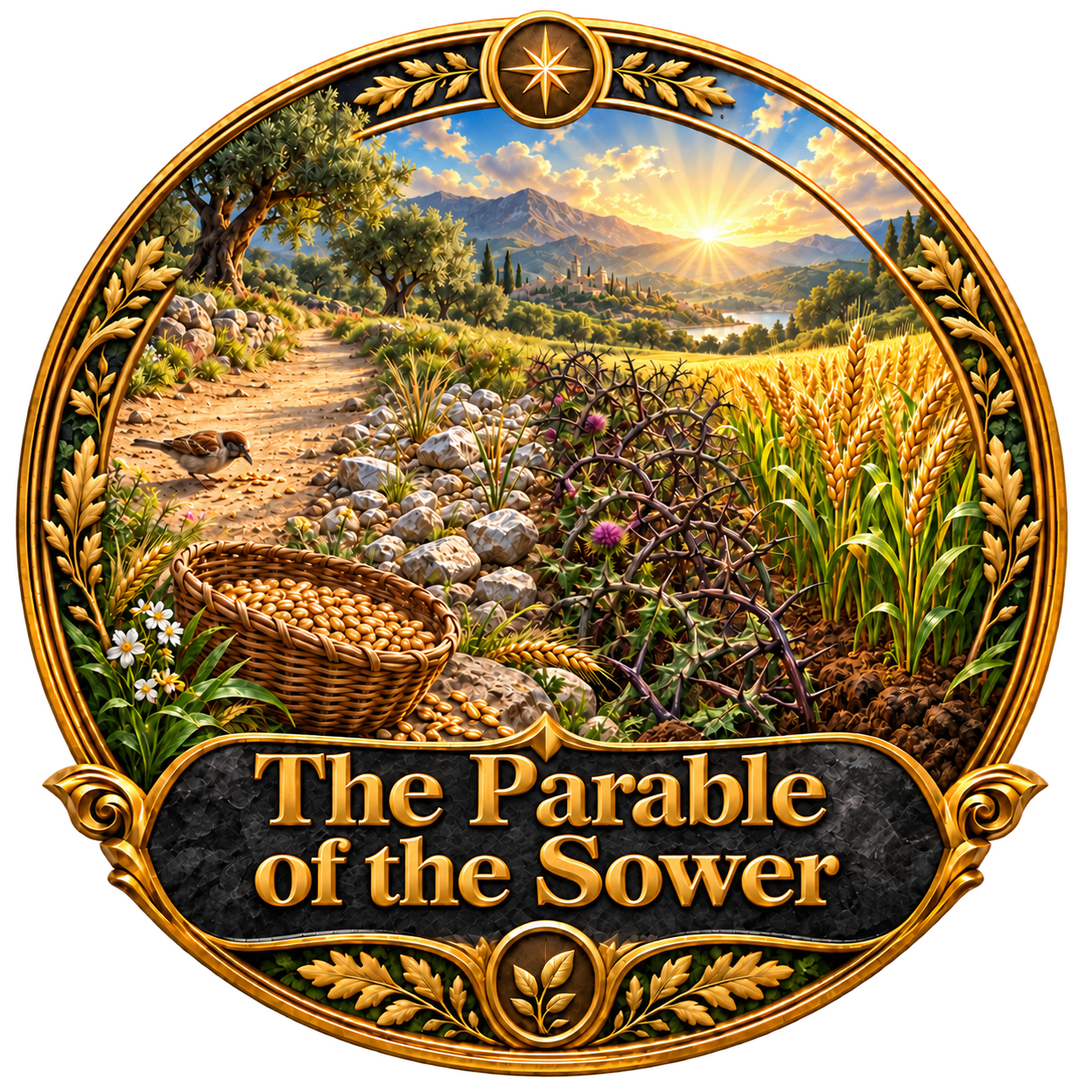
The Parable of the Sower
Plan the route. Hear the word.
Guide a sower through eight route puzzles, carry seeds to good soil and explore Jesus’ parable and its explanation.
Listen to the story.
Jesus begins with a command to listen. He teaches a large crowd from a boat while they remain on the shore, and the story follows a sower’s seed through four different settings. The losses grow more detailed: seed is taken, growth withers, and plants are choked. The ending changes the pattern with a harvest of thirty, sixty and a hundredfold. We have not yet been told what each image means. Let the whole story make its impression before using the explanation in the following verses. Its opening and closing calls to hear make listening part of the subject as well as the activity of the audience.
Follow the repeated pattern
For each setting, identify the seed’s location, what happens next, and the eventual result. Rocky ground is not simply a field containing visible boulders: the story describes shallow soil over rock, quick growth and insufficient root. Thorny ground can support growth, but other growth competes with it. The contrast is therefore more searching than a division between hearing and never hearing. Several responses begin with something happening. Fruitfulness is seen in what endures and matures. Hold those observations until Jesus explains the hearers in verses 14–20.
Let the story govern the game image
The puzzle makes rocks and thorns impassable, gives the player three seeds, and rewards an efficient route. None of those rules interprets Jesus’ account. His sower is not told to identify receptive people before sowing or to withhold the word from difficult ground. Read the game as a memory aid for the four settings, then return to the actual sequence in the passage. The invitation is to hear the whole teaching, including its uncomfortable description of failed responses and its hopeful picture of abundant fruit.
The seed and the word.
When the public story ends, the Twelve and the people around Jesus ask him about the parables. Jesus distinguishes the gift of the kingdom’s mystery from the experience of those outside, and his words echo Isaiah’s language about seeing without perceiving and hearing without understanding. These are difficult words about revelation and judgment, not permission to dismiss people who have questions. The questioners themselves still need explanation. Jesus asks how they will understand the other parables if they do not understand this one, then gives the essential starting point: the sower sows the word.
Ask within the setting of the quotation
Read Isaiah 6:8–13 alongside Mark. Isaiah’s commission joins proclamation with a sobering description of a people who do not respond; judgment and the remaining stump belong to that larger scene. Mark does not explain every question about divine purpose and human response in these few verses. Christian readers differ over how to describe their relationship. Keep the claims you can identify in view: the kingdom’s mystery is given, hearing can fail to become understanding, and Jesus’ own companions need him to open the story for them.
Name the seed before applying the picture
Jesus identifies the sower’s activity as sowing the word; Luke explicitly calls the seed the word of God. This limits our application. The parable is about response to God’s message, not a scheme in which gifts of money produce guaranteed financial returns. It also keeps attention on the message and its reception rather than on the player’s route planning. A good study question is not only what a symbol might suggest to us, but what meaning Jesus has actually supplied for it.
The path.
Jesus begins the explanation with the hearers pictured by the path. The word is sown and heard, but Satan immediately takes it away. The text describes more than a neutral lapse of memory: it presents opposition to the word taking hold. Mark does not tell us to diagnose another person’s heart from a single conversation. The teaching first addresses listeners who must consider their own reception. Notice the two actions in the verse—hearing the word and having it taken away—and compare them with the hearing and accepting that appear in the good-ground explanation.
Compare the emphasis in Matthew
Matthew describes a person who hears the word of the kingdom without understanding it, followed by the evil one snatching away what was sown in the heart. This gives a useful comparison with Mark, but it should remain a comparison rather than a silent addition to Mark’s wording. Both accounts show that exposure to a message is not itself its fruitful reception. When studying, pause over an unclear expression and ask what the passage means before moving to an application.
Practise attentive hearing
A practical response may be to restate the passage in your own words, check your summary against the text, and bring an honest question into conversation with others. Those are suggested learning practices, not a formula that gives us control over spiritual response. The verse’s description is serious, yet its place inside Jesus’ teaching is also an invitation to keep listening. We can attend to the word and pray for understanding without using the soil labels as permanent verdicts on people around us.
Rocky ground.
The rocky-ground hearers receive the word immediately and joyfully. Jesus does not criticise joy; the failure is that this response has no root and lasts only for a time. Trouble or persecution because of the word brings the weakness into view. The phrase ‘because of the word’ matters: this is a particular kind of pressure associated with receiving Jesus’ message. We should not use the passage to treat ordinary sorrow, questions or emotional exhaustion as proof that someone lacks faith. The account invites a deeper examination of what supports a response after its first enthusiasm.
Read beneath the quick beginning
In the story, the seed springs up quickly because the soil is shallow, but the sun scorches it because it has no root. The explanation maps that sequence onto a reception that does not endure under pressure. The same initial speed that looks promising tells us little about the final outcome. Compare the repeated ‘immediately’ in the story and explanation. A community that celebrates only dramatic beginnings can miss the ordinary work of learning, encouragement and patient perseverance that follows.
Consider what endurance requires
Luke says these hearers believe for a time and fall away in a time of testing. Mark focuses on trouble or persecution because of the word. Both direct attention to duration. We can respond by learning the teaching in context, making room for questions, and seeking companions who encourage faithfulness when obedience is costly. Those applications arise from the problem the text identifies; they are not a promise that a sufficiently good routine will prevent every struggle. The parable urges receptive, continuing hearing rather than confidence in a strong first impression.
Among thorns.
Among the thorns, the word is heard but becomes unfruitful. Jesus names the cares of this age, the deceitfulness of riches, and desires for other things as pressures that enter and choke it. These hearers are not described as never having contact with the word. Competing concerns crowd its growth. The reference to riches is especially searching: wealth can promise the security and fullness it cannot finally give. Jesus also names cares and wider desires, so the warning cannot be assigned only to wealthy people. It asks what occupies the attention and trust of a listener.
Notice the competing growth
Thorns do not need to remove the seed from the ground to prevent a crop. In the explanation, the word is choked rather than simply unheard. That image allows a patient examination of a life crowded with concerns: some urgent, some attractive, some apparently ordinary. The text identifies the effect of their competition, but it does not invite us to condemn every responsibility or every possession. Ask when a legitimate concern has become a governing loyalty that consistently displaces response to the word.
Compare Luke’s description of maturity
Luke names cares, riches and pleasures of life and says the hearers bring no fruit to maturity. His wording highlights a process that is interrupted. A possible response is to name one recurring concern, desire or imagined source of security and examine how it affects the choices you make after hearing Scripture. Start with your own priorities. Income, outward busyness and visible success do not disclose everything about another person’s heart, and the puzzle’s thorn tiles cannot measure spiritual maturity.
Good ground and fruit.
The good-ground explanation is brief and active: these people hear the word, receive it, and bear fruit. Mark names yields of thirty, sixty and a hundredfold. Reception has an outcome, yet the outcomes are not described as identical. The verse does not identify fruit with money, prestige or a puzzle score. Its place in the explanation contrasts fruitful reception with a word that is taken away, abandoned under pressure or choked by competing desires. Read it as the positive invitation toward which the entire account has been moving: let hearing become an enduring, fruitful response.
Keep the actions connected
Hearing, accepting and bearing fruit belong together in this sentence. The word is neither a passing sound nor merely an interesting idea. Matthew places understanding in his account of the good-ground hearer; Luke speaks of holding the word and bearing fruit with patience. These emphases can enrich our reading while retaining each Gospel’s wording. The explanation does not offer a detailed scale for calculating another person’s fruitfulness. It gives listeners a direction in which to respond.
Turn one observation into a response
Choose a teaching you can state accurately from the passage. Then name a response that follows from it: asking for understanding, returning to a neglected reading, examining a competing desire, or continuing faithfully through pressure. Give that response time. An efficient route and a quick finished puzzle may be satisfying, but they are poor metaphors for the patience Luke names. The reading can remain open after the game ends; a note revisited later may show what you understood, what you questioned and what changed in practice.
Compare Matthew.
Matthew calls the message ‘the word of the kingdom.’ His explanation gives particular attention to understanding: the path hearer does not understand, while the good-ground hearer hears and understands. The rocky ground and thorns remain recognisable, and the final yields are named in the reverse order from Mark. Reading accounts together is valuable precisely because their wording is not identical. Make a comparison with separate columns before writing a combined summary. That practice helps us hear Matthew’s emphasis and keeps a familiar retelling from becoming a substitute for the text.
Track what understanding changes
In Matthew, understanding appears at both ends of the explanation. It is connected with fruitfulness, not treated as detached knowledge. The middle soils show other failures: temporary reception and the choking influence of care and deceptive riches. Understanding therefore belongs in a response that has duration and effect. A reading practice that gathers information without asking what Jesus is teaching can miss the same issue as one that rushes directly into application without understanding.
Compare without forcing identical wording
Mark includes desires for other things among the thorns; Matthew’s wording in this passage names care and the deceitfulness of riches. Luke names pleasures and patience. You can note these differences without making them compete or assuming that one evangelist’s phrase occurs in all three. Begin with what is shared—word, hearers, obstacles and fruit—then record a phrase that each account contributes. A careful comparison clarifies the teaching more than a quiz about details that have been blended in memory.
Compare Luke.
Luke identifies the seed as the word of God. He says that the devil takes the word from the path hearers so that they may not believe and be saved. The rocky-ground hearers believe for a time but fall away in testing; the thorny hearers do not bring fruit to maturity. The good-ground hearers hold the word in an honest and good heart and bear fruit with patience. Luke’s explanation makes retention and endurance particularly clear. The game ends after three plots are planted, but the reading’s picture of fruitful hearing extends over time.
Follow the language of duration
Compare Luke’s phrases about a time of testing, fruit that does not mature, holding the word, and patient fruitfulness. They describe more than an isolated decision or an outwardly impressive beginning. This does not make the passage a tool for pronouncing on an individual’s final standing. It gives listeners a serious invitation to continue receiving God’s word. Questions about salvation and perseverance should be explored with the wider teaching of Scripture rather than made to rest on an invented puzzle rule.
Finish with a return to the beginning
Read Mark’s story again after studying all three explanations. Which detail now carries more weight? Perhaps the shallow root, the competing thorns or the repeated invitation to hear. Use your final note to connect an observation with a response and a question still worth pursuing. Receptive hearing is sustained by returning, not by pretending to have exhausted the text. The next reading can be slower and more fruitful because the first has taught you what to notice.
Mark 4:1-9
1 And he began again to teach by the sea side: and there was gathered unto him a great multitude, so that he entered into a ship, and sat in the sea; and the whole multitude was by the sea on the land.
2 And he taught them many things by parables, and said unto them in his doctrine,
3 Hearken; Behold, there went out a sower to sow:
4 And it came to pass, as he sowed, some fell by the way side, and the fowls of the air came and devoured it up.
5 And some fell on stony ground, where it had not much earth; and immediately it sprang up, because it had no depth of earth:
6 But when the sun was up, it was scorched; and because it had no root, it withered away.
7 And some fell among thorns, and the thorns grew up, and choked it, and it yielded no fruit.
8 And other fell on good ground, and did yield fruit that sprang up and increased; and brought forth, some thirty, and some sixty, and some an hundred.
9 And he said unto them, He that hath ears to hear, let him hear.
Mark 4:10-14
10 And when he was alone, they that were about him with the twelve asked of him the parable.
11 And he said unto them, Unto you it is given to know the mystery of the kingdom of God: but unto them that are without, all [these] things are done in parables:
12 That seeing they may see, and not perceive; and hearing they may hear, and not understand; lest at any time they should be converted, and [their] sins should be forgiven them.
13 And he said unto them, Know ye not this parable? and how then will ye know all parables?
14 ¶ The sower soweth the word.
Mark 4:15
15 And these are they by the way side, where the word is sown; but when they have heard, Satan cometh immediately, and taketh away the word that was sown in their hearts.
Mark 4:16-17
16 And these are they likewise which are sown on stony ground; who, when they have heard the word, immediately receive it with gladness;
17 And have no root in themselves, and so endure but for a time: afterward, when affliction or persecution ariseth for the word’s sake, immediately they are offended.
Mark 4:18-19
18 And these are they which are sown among thorns; such as hear the word,
19 And the cares of this world, and the deceitfulness of riches, and the lusts of other things entering in, choke the word, and it becometh unfruitful.
Mark 4:20
20 And these are they which are sown on good ground; such as hear the word, and receive [it], and bring forth fruit, some thirtyfold, some sixty, and some an hundred.
Matthew 13:18-23
18 ¶ Hear ye therefore the parable of the sower.
19 When any one heareth the word of the kingdom, and understandeth [it] not, then cometh the wicked [one], and catcheth away that which was sown in his heart. This is he which received seed by the way side.
20 But he that received the seed into stony places, the same is he that heareth the word, and anon with joy receiveth it;
21 Yet hath he not root in himself, but dureth for a while: for when tribulation or persecution ariseth because of the word, by and by he is offended.
22 He also that received seed among the thorns is he that heareth the word; and the care of this world, and the deceitfulness of riches, choke the word, and he becometh unfruitful.
23 But he that received seed into the good ground is he that heareth the word, and understandeth [it]; which also beareth fruit, and bringeth forth, some an hundredfold, some sixty, some thirty.
Luke 8:11-15
11 Now the parable is this: The seed is the word of God.
12 Those by the way side are they that hear; then cometh the devil, and taketh away the word out of their hearts, lest they should believe and be saved.
13 They on the rock [are they], which, when they hear, receive the word with joy; and these have no root, which for a while believe, and in time of temptation fall away.
14 And that which fell among thorns are they, which, when they have heard, go forth, and are choked with cares and riches and pleasures of [this] life, and bring no fruit to perfection.
15 But that on the good ground are they, which in an honest and good heart, having heard the word, keep [it], and bring forth fruit with patience.
Mark 4:14-20
14 ¶ The sower soweth the word.
15 And these are they by the way side, where the word is sown; but when they have heard, Satan cometh immediately, and taketh away the word that was sown in their hearts.
16 And these are they likewise which are sown on stony ground; who, when they have heard the word, immediately receive it with gladness;
17 And have no root in themselves, and so endure but for a time: afterward, when affliction or persecution ariseth for the word’s sake, immediately they are offended.
18 And these are they which are sown among thorns; such as hear the word,
19 And the cares of this world, and the deceitfulness of riches, and the lusts of other things entering in, choke the word, and it becometh unfruitful.
20 And these are they which are sown on good ground; such as hear the word, and receive [it], and bring forth fruit, some thirtyfold, some sixty, and some an hundred.
Luke 8:13
13 They on the rock [are they], which, when they hear, receive the word with joy; and these have no root, which for a while believe, and in time of temptation fall away.
Isaiah 6:8-13
8 Also I heard the voice of the Lord, saying, Whom shall I send, and who will go for us? Then said I, Here [am] I; send me.
9 ¶ And he said, Go, and tell this people, Hear ye indeed, but understand not; and see ye indeed, but perceive not.
10 Make the heart of this people fat, and make their ears heavy, and shut their eyes; lest they see with their eyes, and hear with their ears, and understand with their heart, and convert, and be healed.
11 Then said I, Lord, how long? And he answered, Until the cities be wasted without inhabitant, and the houses without man, and the land be utterly desolate,
12 And the LORD have removed men far away, and [there be] a great forsaking in the midst of the land.
13 ¶ But yet in it [shall be] a tenth, and [it] shall return, and shall be eaten: as a teil tree, and as an oak, whose substance [is] in them, when they cast [their leaves: so] the holy seed [shall be] the substance thereof.
Matthew 13:23
23 But he that received seed into the good ground is he that heareth the word, and understandeth [it]; which also beareth fruit, and bringeth forth, some an hundredfold, some sixty, some thirty.
Mark 4:5-6
5 And some fell on stony ground, where it had not much earth; and immediately it sprang up, because it had no depth of earth:
6 But when the sun was up, it was scorched; and because it had no root, it withered away.
Mark 4:7
7 And some fell among thorns, and the thorns grew up, and choked it, and it yielded no fruit.
Luke 8:14
14 And that which fell among thorns are they, which, when they have heard, go forth, and are choked with cares and riches and pleasures of [this] life, and bring no fruit to perfection.
Luke 8:15
15 But that on the good ground are they, which in an honest and good heart, having heard the word, keep [it], and bring forth fruit with patience.
King James Version
20 And these are they which are sown on good ground; such as hear the word, and receive [it], and bring forth fruit, some thirtyfold, some sixty, and some an hundred.
World English Bible
20 Those which were sown on the good ground are those who hear the word, accept it, and bear fruit, some thirty times, some sixty times, and some one hundred times.”
American Standard Version
20 And those are they that were sown upon the good ground; such as hear the word, and accept it, and bear fruit, thirtyfold, and sixtyfold, and a hundredfold.
Young’s Literal Translation
20 'And these are they who on the good ground have been sown: who do hear the word, and receive, and do bear fruit, one thirty-fold, and one sixty, and one an hundred.'
Darby Translation
20 And these are they who have been sown on the good ground, such as hear the word and receive it, and bear fruit; one thirty, and one sixty, and one a hundred [fold].