The Tabernacle God Dwelling Among His People
From the mountain pattern to the glory-filled tent: materials, makers, sacred spaces and the meaning of God’s dwelling.
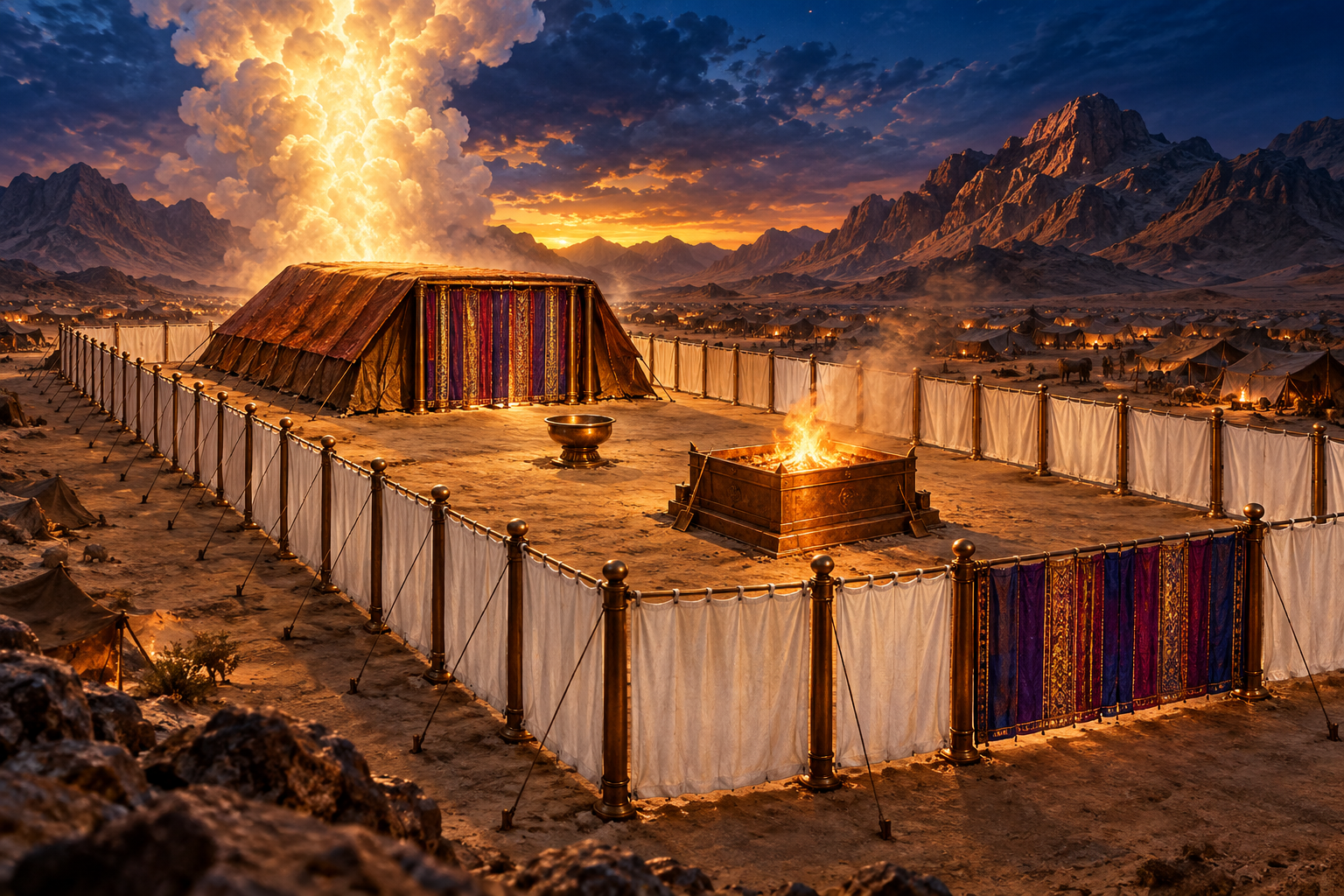
Original illustration created for this study. Conceptual artwork; materials, scale and appearance in the image are not evidence for a historical reconstruction.
From the pattern to the presence
Exodus does not end with an escape alone. The God who brought Israel out of Egypt comes to dwell among a covenant people. The Tabernacle is a movable sanctuary: a courtyard surrounding a tent, with carefully specified furnishings, appointed priests, and ordered service. Its beauty and its boundaries belong together. God draws near, yet Israel cannot treat his holiness casually. Follow the actual instructions, the interrupted covenant story, the community’s craftsmanship, the completed building, and its life within Israel before considering how the New Testament reads it.
Exodus 12–24: deliverance, Sinai, covenant and Moses on the mountain.
Exodus 25–31: the sanctuary pattern, furniture, priesthood and craftsmen.
Exodus 32–34: the golden calf, Moses’ intercession and renewed covenant.
Exodus 35–39: willing offerings, skilled work, inspection and blessing.
Exodus 40: the tent is erected in the second year; the cloud and glory fill it.
Leviticus and Numbers: consecration, worship, holiness and movement with the camp.
Use the chapter links for a guided course or explore one object at a time. Scripture panels contain selected WEB passages for offline reading; full-chapter links need internet. Notes, review selections and completion marks save only on this device when browser storage is available. Export notes for your own backup. No notes or quiz responses are sent by this study.
Explore the sacred spaces
Select an object below the schematic. North is up; the entrance is east. Relative positions follow Exodus 40; dimensions and spacing are schematic. The drawing is not an unrestricted visitor route.
The courtyard and eastern gate
The linen enclosure is 100 × 50 cubits, with hangings 5 cubits high. Its embroidered eastern gate is 20 cubits wide. The diagram shows orientation and broad relationships; exact furniture spacing is not supplied.
Exodus 27:9-19 · Study this part ↓
Why build a dwelling for God?
The command begins with God’s purpose, rather than a building technique: Israel is to make a sanctuary so that he may dwell among them. The sanctuary belongs inside the story of the exodus and the Sinai covenant. God identifies himself as the one who brought them out of Egypt in order to dwell among them. The building does not earn their rescue, imprison God within a structure, or supply a need in him. It is his appointed place of meeting and service among his people. Exodus 25:8-9 Exodus 29:43-46
Tabernacle means dwelling. Sanctuary emphasizes holiness. Tent of Meeting emphasizes encounter with God, and Tabernacle of the Testimony relates it to the covenant testimony associated with the ark. The word “tabernacle” can refer to the inner fabric dwelling or, more broadly, the complete sanctuary complex; context matters. The court is outside the tent, the Holy Place is inside its entrance, and the Most Holy Place is beyond the inner veil. These are related spaces with different access rules. Exodus 26:1 Exodus 26:33 Exodus 38:21
Numbers presents Israel’s camp arranged around the sanctuary, with the Levites attending it. The physical center reflects a theological center: life together is organized around God’s presence and command. Yet the climax of Exodus is not human achievement. After Moses finishes the work, the cloud covers the tent and God’s glory fills it; even Moses cannot enter at that moment. Numbers 1:50-53 Numbers 2:17 Exodus 40:33-38
8 Let them make me a sanctuary, that I may dwell among them. 9 According to all that I show you, the pattern of the tabernacle, and the pattern of all of its furniture, even so you shall make it.
Read Exodus 25:8–9 (WEB) in context ↗
45 I will dwell among the children of Israel, and will be their God. 46 They shall know that I am Yahweh their God, who brought them out of the land of Egypt, that I might dwell among them: I am Yahweh their God.
Read Exodus 29:45–46 (WEB) in context ↗
The story before the building
Read the chapters in their narrative order. Moses goes up Sinai, and Exodus 24:18 records forty days and forty nights. The sanctuary instructions occupy chapters 25–31. Meanwhile, chapter 32 narrates the golden calf: while God gives the pattern for his dwelling, the people produce an unauthorized image. The crisis includes broken tablets, judgment and Moses’ intercession. Chapters 33–34 concern God’s presence, mercy, renewed tablets and covenant renewal. Only then do chapters 35–39 narrate the community making the sanctuary. Exodus 24:18 Exodus 32:1-8 Exodus 32:19 Exodus 34:1-10
The Sabbath command stands at both the close of the instructions and the beginning of the work account. Even sanctuary work takes place under God’s command; sacred construction is not permission to ignore the covenant sign of rest. Exodus 34:28 records a further forty days and nights with Moses on the mountain. These statements do not supply the exact number of days spent weaving, casting, carving and assembling the Tabernacle. Do not calculate a precise building duration by adding dates that the narrative does not give. Exodus 31:12-17 Exodus 34:28 Exodus 35:1-3
Exodus 33 also describes a tent Moses pitches outside the camp, where he meets with God and Joshua remains. It is called a Tent of Meeting, but the completed sanctuary is not erected until chapter 40. Keep this provisional outside-the-camp tent distinct within the narrative from the later constructed sanctuary and its ordered place among Israel. Exodus does not describe the earlier tent’s size, furniture or manufacturing history. Exodus 33:7-11 Exodus 40:17
7 Now Moses used to take the tent and pitch it outside the camp, far away from the camp, and he called it “The Tent of Meeting.” Everyone who sought Yahweh went out to the Tent of Meeting, which was outside the camp. 8 When Moses went out to the Tent, all the people rose up, and stood, everyone at their tent door, and watched Moses, until he had gone into the Tent. 9 When Moses entered into the Tent, the pillar of cloud descended, stood at the door of the Tent, and Yahweh spoke with Moses. 10 All the people saw the pillar of cloud stand at the door of the Tent, and all the people rose up and worshiped, everyone at their tent door. 11 Yahweh spoke to Moses face to face, as a man speaks to his friend. He turned again into the camp, but his servant Joshua, the son of Nun, a young man, didn’t depart from the Tent.
Read Exodus 33:7–11 (WEB) in context ↗
1 Moses assembled all the congregation of the children of Israel, and said to them, “These are the words which Yahweh has commanded, that you should do them. 2 ‘Six days shall work be done, but on the seventh day there shall be a holy day for you, a Sabbath of solemn rest to Yahweh: whoever does any work in it shall be put to death. 3 You shall kindle no fire throughout your habitations on the Sabbath day.’”
Read Exodus 35:1–3 (WEB) in context ↗
What the people brought
God calls for contributions from willing hearts. Men and women bring jewelry, metals, cloth, hides and wood; skilled women spin; leaders supply stones, spices and oil. The repeated language of willingness is explicit. Eventually the workers report that there is more than enough, and Moses orders the contributions to stop. This is not a story of endless extraction: the actual work determines when enough has been received. Exodus 25:1-7 Exodus 35:20-29 Exodus 36:2-7
Gold, silver, bronze
Gold: inner furniture and overlays. Silver: bases, hooks and connecting bands. Bronze: outer altar, basin, court bases and pegs.
Blue, purple, scarlet, fine twisted linen
Inner curtains, veil, entrance screens and priestly garments. The text names colors and fabrics; it does not explain a doctrine for each color.
Goats’ hair; red-dyed ram skins; outer hides
The woven tent layer and protective skin coverings. The outer hide’s Hebrew identification is uncertain; English versions differ.
Acacia wood
Boards or frames, bars, poles, ark, table and both altars.
Olive oil, aromatic spices
Lamp fuel, specially compounded anointing oil and sacred incense.
Onyx and setting stones
The ephod’s shoulder stones and the breastplate’s twelve engraved stones.
Exodus earlier records Israelites receiving silver, gold and clothing from Egyptians; this supplies part of the narrative background to their possessions. The building account does not trace every piece of wood, gemstone or spice to a purchase or location. It says that those who possessed the needed materials brought them. Avoid filling those gaps with a detailed desert supply chain, invented mining expeditions or claims that every object came from Egypt. Exodus 12:35-36 Exodus 35:23-24
The silver also has a specific accounting connection to the census contribution: a half-shekel per counted man, with rich and poor giving the same prescribed amount. That commanded contribution should be distinguished from the freewill offering language surrounding the general material collection. Exodus 30:11-16 Exodus 38:25-28
25 All the women who were wise-hearted spun with their hands, and brought that which they had spun: the blue, the purple, the scarlet, and the fine linen. 26 All the women whose heart stirred them up in wisdom spun the goats’ hair. 27 The rulers brought the onyx stones and the stones to be set for the ephod and for the breastplate; 28 with the spice and the oil for the light, for the anointing oil, and for the sweet incense. 29 The children of Israel brought a free will offering to Yahweh; every man and woman whose heart made them willing to bring for all the work, which Yahweh had commanded to be made by Moses.
Read Exodus 35:25–29 (WEB) in context ↗
4 All the wise men, who performed all the work of the sanctuary, each came from his work which he did. 5 They spoke to Moses, saying, “The people have brought much more than enough for the service of the work which Yahweh commanded to make.” 6 Moses gave a commandment, and they caused it to be proclaimed throughout the camp, saying, “Let neither man nor woman make anything else for the offering for the sanctuary.” So the people were restrained from bringing. 7 For the stuff they had was sufficient to do all the work, and too much.
Read Exodus 36:4–7 (WEB) in context ↗
The people who made and served it
The Tabernacle is not attributed to Moses’ craftsmanship alone. God gives the pattern and equips the makers; Moses communicates the commands, receives offerings, appoints the work, inspects the finished parts, blesses the people and erects the sanctuary. The repeated “as Yahweh commanded Moses” measures the project by fidelity to the command rather than by artistic novelty. Exodus 25:9 Exodus 36:2-3 Exodus 39:42-43 Exodus 40:16-18
Bezalel, son of Uri, son of Hur, Judah
Named and filled with God’s Spirit for wisdom and skill in metalwork, stonework and woodwork; the ark’s making is specifically attributed to him. Exodus 31:1–5; 37:1.
Oholiab, son of Ahisamach, Dan
Appointed with Bezalel; skilled in engraving, designing and embroidery. Both are equipped to teach others. Exodus 31:6; 35:34–35; 38:23.
Other skilled workers
Carry out the varied crafts with wisdom and willing participation. The account recognizes a team, not merely two exceptional individuals. Exodus 36:1–2.
Women
Give offerings; skilled women spin colored yarn and linen, and others spin goats’ hair. Women serving at the entrance contribute bronze mirrors used for the basin and stand; the passage does not explain their precise duties. Exodus 35:22, 25–26; 38:8.
Leaders and the congregation
Provide stones, spices, oil and the wider material supply. Exodus 35:27–29.
Ithamar, Aaron’s son
Associated with the Levites’ accounting at Moses’ command; later supervises Gershonite and Merarite service. Exodus 38:21; Numbers 4:28, 33.
Aaron and his sons
Appointed priests: Nadab, Abihu, Eleazar and Ithamar are named at the beginning. Consecration and priestly service are different responsibilities from construction. Exodus 28:1; Leviticus 8–10.
Eleazar and the Levites
Eleazar oversees sanctuary responsibilities and specified supplies; Levite families guard and transport their assigned parts. Not every Levite is an Aaronic priest. Numbers 3:6–10, 32; 4:16.
The Spirit’s enabling includes practical judgment, beautiful design, skilled hands and teaching. The account gives spiritual importance to responsible work and shared knowledge. It does not name every spinner, carver or carrier; lack of a preserved name does not mean lack of a real contribution. Exodus 35:30-35
1 Yahweh spoke to Moses, saying, 2 “Behold, I have called by name Bezalel the son of Uri, the son of Hur, of the tribe of Judah. 3 I have filled him with the Spirit of God, in wisdom, and in understanding, and in knowledge, and in all kinds of workmanship, 4 to devise skillful works, to work in gold, and in silver, and in bronze, 5 and in cutting of stones for setting, and in carving of wood, to work in all kinds of workmanship. 6 Behold, I myself have appointed with him Oholiab, the son of Ahisamach, of the tribe of Dan; and in the heart of all who are wise-hearted I have put wisdom, that they may make all that I have commanded you:
Read Exodus 31:1–6 (WEB) in context ↗
34 He has put in his heart that he may teach, both he and Oholiab, the son of Ahisamach, of the tribe of Dan. 35 He has filled them with wisdom of heart to work all kinds of workmanship, of the engraver, of the skillful workman, and of the embroiderer, in blue, in purple, in scarlet, and in fine linen, and of the weaver, even of those who do any workmanship, and of those who make skillful works.
Read Exodus 35:34–35 (WEB) in context ↗
Measurements and the material accounts
A cubit is a forearm-based measure. Ancient standards varied, and Exodus does not give a modern conversion. Using about 0.45 m (18 inches) per cubit helps imagine scale, but it should not create false precision. Thus a 100 × 50 cubit court is approximately 45 × 22.5 m under that chosen conversion. The tables in this study preserve the primary units. A handbreadth is a smaller hand-based measure and a span is approximately half a cubit; do not confuse the table’s handbreadth rim with the breastplate’s span. Exodus 25:25 Exodus 28:16
The tent is commonly reconstructed as roughly 30 cubits long, 10 wide and 10 high, with a 20-cubit Holy Place and a 10-cubit Most Holy Place. The 10-cubit board height and twenty side boards each 1½ cubits wide are stated. The width, corners, curtain placement and resulting room proportions require the details to be assembled into a reconstruction. Exodus does not simply provide a single sentence giving all three overall tent dimensions or both rooms’ dimensions. Our schematic follows the common arrangement while marking it as schematic. Exodus 26:15-25 Exodus 26:31-35
Gold
29 talents + 730 sanctuary shekels
Gold used for the sanctuary work, from the offering.
Silver
100 talents + 1,775 sanctuary shekels
603,550 counted men × half a shekel. The 100 talents provide 100 bases at one talent each; the remainder provides hooks, capital overlays and connecting bands.
Bronze
70 talents + 2,400 sanctuary shekels
Used for entrance and court bases, outer altar and grating, utensils and pegs as listed.
The silver figures imply 3,000 shekels to the talent in this account: 603,550 ÷ 2 = 301,775 shekels, matching 100 talents plus 1,775 shekels. This is arithmetic from the text, not an extra revelation. The 100 silver bases correspond to 96 under the 48 boards and four under the inner veil’s pillars. The tent entrance has five bronze bases. Exact modern kilogram totals depend on the ancient weight standard chosen, so they are omitted here. Exodus 26:19-25 Exodus 26:32-37 Exodus 38:24-31
24 All the gold that was used for the work in all the work of the sanctuary, even the gold of the offering, was twenty-nine talents and seven hundred thirty shekels, according to the shekel of the sanctuary. 25 The silver of those who were counted of the congregation was one hundred talents and one thousand seven hundred seventy-five shekels, according to the shekel of the sanctuary: 26 a beka a head, that is, half a shekel, according to the shekel of the sanctuary, for everyone who passed over to those who were counted, from twenty years old and upward, for six hundred three thousand five hundred fifty men. 27 The one hundred talents of silver were for casting the sockets of the sanctuary and the sockets of the veil: one hundred sockets for the one hundred talents, one talent per socket. 28 From the one thousand seven hundred seventy-five shekels he made hooks for the pillars, overlaid their capitals, and made fillets for them.
Read Exodus 38:24–28 (WEB) in context ↗
The courtyard, pillars and eastern gate
The outer court is a rectangle, 100 cubits long and 50 wide, enclosed by fine twisted linen hangings 5 cubits high. The south and north sides each have 100 cubits of hanging with twenty pillars and twenty bronze bases. The west has 50 cubits with ten pillars. On the east, a central 20-cubit entrance screen is flanked by 15-cubit hangings on each side, supported by three pillars on each side; the gate screen has four. This gives sixty stated court pillar positions in the description. Exodus 27:9-18
The hooks and connecting bands or fillets are silver, and Exodus 38 also mentions silver covering the capitals. Bases and pegs are bronze. Cords and pegs secure the structure. The material of the court pillars themselves is not expressly identified in these verses; bronze bases should not silently become solid-bronze pillars in a study diagram. The entrance screen is embroidered with blue, purple and scarlet along with fine twisted linen. It is a fabric entrance, not a stone gateway. Exodus 27:16-19 Exodus 38:17-20
The eastern entrance establishes a broad east-to-west approach. Inside the court are the burnt-offering altar and the basin; the basin stands between altar and tent. The tent’s own entrance leads into the Holy Place. The biblical description supplies these relationships, but does not fix every object’s distance from the next. Nor should a drawing of the court imply that every Israelite could walk through every space: priestly boundaries and purity regulations govern approach. Exodus 40:6-8 Exodus 40:29-33 Numbers 18:1-7
16 For the gate of the court shall be a screen of twenty cubits, of blue, and purple, and scarlet, and fine twined linen, the work of the embroiderer; their pillars four, and their sockets four. 17 All the pillars of the court around shall be filleted with silver; their hooks of silver, and their sockets of bronze. 18 The length of the court shall be one hundred cubits, and the width fifty throughout, and the height five cubits, of fine twined linen, and their sockets of bronze. 19 All the instruments of the tabernacle in all its service, and all its pins, and all the pins of the court, shall be of bronze.
Read Exodus 27:16–19 (WEB) in context ↗
The bronze altar of burnt offering
The large outer altar is made of acacia wood overlaid with bronze. Its plan is square: 5 × 5 cubits, and its height 3 cubits. Four horns at its corners are of one piece with it. It is hollow, made with boards, rather than a solid block of metal. A bronze network grating reaches halfway up beneath its ledge, and four bronze rings receive bronze-covered acacia carrying poles on its two sides. Exodus 27:1-8
Its tools include ash pots, shovels, basins, forks or meat hooks, and firepans, all bronze. These are integral to a working place of sacrifice, fire, blood and ash. Leviticus specifies different offerings and different treatment of their portions. It would be misleading to say that every sacrifice was burned whole: the burnt offering is distinct from offerings in which priests or worshipers receive portions under their respective rules. Exodus 38:3 Leviticus 1:8-9 Leviticus 6:24-30 Leviticus 7:11-18
The altar stands before the tent entrance in the court. Priests tend its fire and remove ashes according to the command. Leviticus 6 stresses that its fire is to be kept burning. Exodus does not furnish a full cross-section explaining how every surface handled heat, nor does the Tabernacle passage describe a particular access ramp. Drawings often supply practical details; those details should be labeled as reconstruction. The general altar command in Exodus 20:26 forbids ascending by steps that expose nakedness, but it does not itself specify the design of this altar’s approach. Exodus 40:29 Leviticus 6:8-13 Exodus 20:26
1 “You shall make the altar of acacia wood, five cubits long, and five cubits wide. The altar shall be square. Its height shall be three cubits. 2 You shall make its horns on its four corners. Its horns shall be of one piece with it. You shall overlay it with bronze. 3 You shall make its pots to take away its ashes; and its shovels, its basins, its meat hooks, and its fire pans. You shall make all its vessels of bronze.
Read Exodus 27:1–3 (WEB) in context ↗
12 The fire on the altar shall be kept burning on it, it shall not go out; and the priest shall burn wood on it every morning. He shall lay the burnt offering in order upon it, and shall burn on it the fat of the peace offerings. 13 Fire shall be kept burning on the altar continually; it shall not go out.
Read Leviticus 6:12–13 (WEB) in context ↗
The bronze basin and its base
God commands a bronze basin with a bronze base, filled with water and placed between the tent and the outer altar. Aaron and his sons wash their hands and feet before entering the Tent of Meeting or approaching the altar to serve. The warning “that they not die” makes the washing a matter of commanded holiness rather than optional tidiness. Exodus 40 says Moses, Aaron and his sons wash there when the sanctuary is set up. Exodus 30:17-21 Exodus 40:30-32
The basin and its stand are made from the bronze mirrors of the women who served at the entrance of the Tent of Meeting. Ancient metal mirrors were reflective objects; the verse identifies the material source without giving the women’s names or a detailed description of their service. It is unnecessary to invent their exact office or suggest that the mirrors themselves were morally suspect. The text’s emphasis is the contribution and the resulting basin. Exodus 38:8
No dimensions, water capacity, exact silhouette or number of taps are given. A shallow bowl on a pedestal in an illustration is a visual reconstruction. The washing at this basin concerns priests’ hands and feet during service; distinguish it from the washing of the priests at their initial consecration and the whole-body bathing described for the Day of Atonement. Exodus 29:4 Leviticus 16:4
18 “You shall also make a basin of bronze, and its base of bronze, in which to wash. You shall put it between the Tent of Meeting and the altar, and you shall put water in it. 19 Aaron and his sons shall wash their hands and their feet in it. 20 When they go into the Tent of Meeting, they shall wash with water, that they don’t die; or when they come near to the altar to minister, to burn an offering made by fire to Yahweh. 21 So they shall wash their hands and their feet, that they not die. This shall be a statute forever to them, even to him and to his descendants throughout their generations.”
Read Exodus 30:18–21 (WEB) in context ↗
8 He made the basin of bronze, and its base of bronze, out of the mirrors of the ministering women who ministered at the door of the Tent of Meeting.
Read Exodus 38:8 (WEB) in context ↗
The upright framework, bases and bars
The tent’s supporting boards or frames are upright acacia pieces 10 cubits long and 1½ cubits wide, each with two tenons fitted into two silver bases. The south has twenty boards and forty bases; the north likewise has twenty and forty. The west has six boards plus two specially described corner boards, making eight boards and sixteen bases. The biblical description totals forty-eight boards and ninety-six bases for this framework. Exodus 26:15-25
Five acacia bars are provided for each long side and five for the west side. The middle bar passes through from end to end. Boards and bars are overlaid with gold, and gold rings receive the bars. This is a joined, braced structure made for erection and dismantling. The text does not give a board’s thickness. Translators and reconstructions differ over whether these should be imagined as solid planks or open frames and over the corner joinery. Preserve the dimensions without pretending the Hebrew description supplies an uncontested modern engineering drawing. Exodus 26:26-30
The tent also has pillars for its two inner boundaries: four acacia pillars overlaid with gold stand on silver bases for the veil, and five gold-overlaid pillars stand on bronze bases for the entrance screen. These are separate from the forty-eight boards and the court pillars. The deliberate differences in bases and fabrics help prevent those support systems from being confused. Exodus 26:31-37
15 “You shall make the boards for the tabernacle of acacia wood, standing upright. 16 Ten cubits shall be the length of a board, and one and a half cubits the width of each board. 17 There shall be two tenons in each board, joined to one another: thus you shall make for all the boards of the tabernacle. 18 You shall make twenty boards for the tabernacle, for the south side southward. 19 You shall make forty sockets of silver under the twenty boards; two sockets under one board for its two tenons, and two sockets under another board for its two tenons.
Read Exodus 26:15–19 (WEB) in context ↗
26 “You shall make bars of acacia wood: five for the boards of the one side of the tabernacle, 27 and five bars for the boards of the other side of the tabernacle, and five bars for the boards of the side of the tabernacle, for the far side westward. 28 The middle bar in the middle of the boards shall pass through from end to end. 29 You shall overlay the boards with gold, and make their rings of gold for places for the bars. You shall overlay the bars with gold. 30 You shall set up the tabernacle according to the way that it was shown to you on the mountain.
Read Exodus 26:26–30 (WEB) in context ↗
The curtains and four covering layers
The description moves from the decorated inner dwelling outward to protective coverings. Distinguish the woven linen curtains from the goats’-hair tent and both skin layers. Not all the layers are the same material, size or fastening system. Exodus 26:1-14
1. Fine twisted linen curtains
Ten curtains, each 28 × 4 cubits; blue, purple and scarlet with worked cherubim. Two sets of five are joined. Fifty blue loops face fifty loops at their joining edges; fifty gold clasps unite the two sets.
2. Goats’-hair tent
Eleven curtains, each 30 × 4 cubits, arranged in sets of five and six. Fifty loops on each joining edge and fifty bronze clasps. The sixth curtain is doubled at the front; surplus fabric hangs at the rear and sides.
3. Red-dyed ram skins
A covering over the tent. No dimensions or seam pattern are stated.
4. Outer hides
An outer covering above. Its Hebrew material name is uncertain; WEB uses “sea cow hides” in Exodus and other English editions use different terms. The identity is not settled by selecting one English rendering.
The joined linen panels have a combined flat area conventionally expressed as 28 × 40 cubits, and the eleven goats’-hair panels as 30 × 44 cubits before folding and overlap. These are panel calculations, not two flat roof dimensions: fabric also hangs down the sides and back. Exodus describes the overhang but does not explicitly prescribe a modern roof pitch or provide dimensions for a ridgepole. A flat or pitched roof in a model reflects reconstruction choices. Exodus 26:9-14
The cherubim belong to the woven inner curtains and the inner veil, while the entrance screens are described as embroidery without cherubim being specified there. That difference should be respected in diagrams. Neither the species and anatomy of the cherubim nor the precise pattern repeat of the woven figures is supplied. Exodus 26:1 Exodus 26:31 Exodus 26:36
1 “Moreover you shall make the tabernacle with ten curtains of fine twined linen, and blue, and purple, and scarlet, with cherubim. You shall make them with the work of a skillful workman. 2 The length of each curtain shall be twenty-eight cubits, and the width of each curtain four cubits: all the curtains shall have one measure. 3 Five curtains shall be coupled together to one another, and the other five curtains shall be coupled to one another. 4 You shall make loops of blue on the edge of the one curtain from the edge in the coupling, and you shall do likewise on the edge of the curtain that is outermost in the second coupling. 5 You shall make fifty loops in the one curtain, and you shall make fifty loops in the edge of the curtain that is in the second coupling. The loops shall be opposite one another. 6 You shall make fifty clasps of gold, and couple the curtains to one another with the clasps. The tabernacle shall be a unit. 7 “You shall make curtains of goats’ hair for a covering over the tabernacle. You shall make eleven curtains.
Read Exodus 26:1–7 (WEB) in context ↗
13 The cubit on the one side and the cubit on the other side, of that which remains in the length of the curtains of the tent, shall hang over the sides of the tabernacle on this side and on that side, to cover it. 14 You shall make a covering for the tent of rams’ skins dyed red, and a covering of sea cow hides above.
Read Exodus 26:13–14 (WEB) in context ↗
Three fabric boundaries and two inner rooms
There are three different fabric boundaries along the approach: the court’s eastern gate screen, the tent’s entrance screen, and the inner veil. The court gate is 20 cubits wide with four pillars and bronze bases. The tent entrance hangs on five gold-overlaid acacia pillars with gold hooks and bronze bases. The inner veil hangs on four gold-overlaid acacia pillars with gold hooks and silver bases. All three use blue, purple, scarlet and fine twisted linen, but the inner veil explicitly has worked cherubim. Exodus 27:16 Exodus 26:31-37
The veil divides the Holy Place from the Most Holy Place. The ark with its atonement cover is behind it. Outside it, the table is on the north and the lampstand opposite on the south; the golden incense altar stands before the veil. This placement comes from Exodus itself. The familiar 20 × 10 and 10 × 10 cubit room plans are a reconstruction from the total structure and curtain arrangement, rather than room measurements stated together in these verses. Exodus 26:33-35 Exodus 40:22-26
The division is an access boundary, not merely a change of decoration. Ordinary priestly service takes place in the first room; the high priest enters the inner sanctuary under the special annual atonement regulations. The statement “once in the year” describes the annual rite; Leviticus 16 includes several actions and entrances in its performance, rather than establishing that the high priest physically crossed the veil only once during that day. Hebrews 9:6-7 Leviticus 16:11-17 Leviticus 16:23
31 “You shall make a veil of blue, and purple, and scarlet, and fine twined linen, with cherubim. It shall be the work of a skillful workman. 32 You shall hang it on four pillars of acacia overlaid with gold; their hooks shall be of gold, on four sockets of silver. 33 You shall hang up the veil under the clasps, and shall bring the ark of the covenant in there within the veil. The veil shall separate the holy place from the most holy for you. 34 You shall put the mercy seat on the ark of the covenant in the most holy place. 35 You shall set the table outside the veil, and the lamp stand opposite the table on the side of the tabernacle toward the south. You shall put the table on the north side.
Read Exodus 26:31–35 (WEB) in context ↗
The ark, atonement cover and cherubim
The ark is an acacia chest 2½ cubits long, 1½ wide and 1½ high, overlaid with pure gold inside and outside and finished with a gold molding. Four gold rings are attached at its four feet or corners, two on each side. Gold-covered acacia poles carry it, and Exodus 25:15 says they are to remain in the rings. Its placement in the innermost room does not make it a statue of God. It receives the covenant testimony and is associated with God’s appointed speech and meeting. Exodus 25:10-16
A pure-gold cover, often called the mercy seat or atonement cover, measures 2½ × 1½ cubits. Two hammered-gold cherubim are made at its ends as one piece with the cover. They face one another toward the cover, spreading wings above it. God promises to speak from above the cover, between the cherubim. The text does not describe God’s bodily image sitting there. It also does not identify the cherubim as the familiar winged infants of later art. Exodus 25:17-22 Numbers 7:89
When the tent is erected, Moses puts the testimony into the ark. Other passages connect memorial objects with the sanctuary: the manna is laid before the testimony, and Aaron’s budded staff is later placed before it. Hebrews 9:4 lists a golden manna jar, the staff and the covenant tablets in connection with the ark and says “in which.” First Kings 8:9 says that at Solomon’s dedication only the two tablets were in the ark. Read each statement in its own setting; do not claim Exodus 40 explicitly says Moses placed all three objects inside on the first day. Exodus 40:20 Exodus 16:32-34 Numbers 17:10 Hebrews 9:4 1 Kings 8:9
17 You shall make a mercy seat of pure gold. Two and a half cubits shall be its length, and a cubit and a half its width. 18 You shall make two cherubim of hammered gold. You shall make them at the two ends of the mercy seat. 19 Make one cherub at the one end, and one cherub at the other end. You shall make the cherubim on its two ends of one piece with the mercy seat. 20 The cherubim shall spread out their wings upward, covering the mercy seat with their wings, with their faces toward one another. The faces of the cherubim shall be toward the mercy seat. 21 You shall put the mercy seat on top of the ark, and in the ark you shall put the covenant that I will give you. 22 There I will meet with you, and I will tell you from above the mercy seat, from between the two cherubim which are on the ark of the covenant, all that I command you for the children of Israel.
Read Exodus 25:17–22 (WEB) in context ↗
20 He took and put the covenant into the ark, and set the poles on the ark, and put the mercy seat above on the ark. 21 He brought the ark into the tabernacle, and set up the veil of the screen, and screened the ark of the covenant, as Yahweh commanded Moses.
Read Exodus 40:20–21 (WEB) in context ↗
The table and the bread of the Presence
The acacia table measures 2 cubits long, 1 wide and 1½ high. It is overlaid with pure gold, has gold moldings and a surrounding rim or border a handbreadth wide, and has four gold rings at the corners associated with its four legs. The rings near the rim receive gold-covered acacia carrying poles. Dishes, spoons or ladles, and vessels for pouring are pure gold. Translate the object names carefully: English versions vary, and the text does not explain every vessel’s exact shape. Exodus 25:23-29
Moses places the table on the north side of the Holy Place and arranges the bread before God. Exodus requires the bread to be before him continually. Leviticus gives the fuller bread instructions: twelve cakes made of fine flour, each using two-tenths of an ephah, arranged as two rows or groups of six on the pure-gold table. Pure frankincense accompanies the arrangements as a memorial portion offered by fire. Each Sabbath the bread is set in order; it belongs to Aaron and his sons to eat in a holy place. Exodus 25:30 Exodus 40:22-23 Leviticus 24:5-9
“Showbread” and “bread of the Presence” are common names for this bread. Its continual placement belongs to Israel’s covenant service before God. Twelve loaves naturally invite comparison with the twelve tribes, but Leviticus 24 does not state in so many words “each loaf represents one tribe”; label that connection as an interpretive observation. The passage does explicitly call the arrangement an everlasting covenant on behalf of Israel. This is holy provision and appointed remembrance, rather than food supplied because God is hungry. Leviticus 24:8-9
5 “You shall take fine flour, and bake twelve cakes of it: two tenths of an ephah shall be in one cake. 6 You shall set them in two rows, six on a row, on the pure gold table before Yahweh. 7 You shall put pure frankincense on each row, that it may be to the bread for a memorial, even an offering made by fire to Yahweh. 8 Every Sabbath day he shall set it in order before Yahweh continually. It is an everlasting covenant on the behalf of the children of Israel. 9 It shall be for Aaron and his sons. They shall eat it in a holy place; for it is most holy to him of the offerings of Yahweh made by fire by a perpetual statute.”
Read Leviticus 24:5–9 (WEB) in context ↗
The gold lampstand and its seven lamps
The lampstand is hammered work of pure gold. Its base, stem, cups, buds or knobs, and flowers form one piece. Six branches extend from the sides, three on each side of the central stem, making seven lamp positions. Each branch has three almond-flower-shaped cups with buds and flowers; the central stem has four cups, with buds beneath the branch pairs. Seven lamps are made for it and arranged to give light in front. The description is botanical and crafted, rather than a set of wax candles. Exodus 25:31-37
Its snuffers or wick tools and trays are pure gold. The lampstand and these utensils are made from a talent of pure gold. The text gives that weight but supplies no overall height, arm span or base diameter; museum models necessarily choose dimensions. Its position is on the south side of the Holy Place, opposite the table. Exodus 25:38-40 Exodus 37:23-24 Exodus 40:24-25
The people supply pure beaten olive oil for the light. Aaron and his sons tend the lamps from evening to morning, continually according to the appointed service. Exodus 30 links morning lamp tending and evening lighting with incense service. “Continually” should be read alongside those explicit rhythms, rather than used to invent a precise daily schedule for every lamp beyond the text. Exodus 27:20-21 Exodus 30:7-8 Leviticus 24:1-4
Christian readers may connect light with themes elsewhere in Scripture, but Exodus does not identify each branch with a particular church or assign a doctrine to each almond cup. Later uses of lampstand imagery, such as Revelation 1:20, give their meanings in their own visions. Begin with the actual object and its service before making a theological comparison.
31 “You shall make a lamp stand of pure gold. The lamp stand shall be made of hammered work. Its base, its shaft, its cups, its buds, and its flowers shall be of one piece with it. 32 There shall be six branches going out of its sides: three branches of the lamp stand out of its one side, and three branches of the lamp stand out of its other side;
Read Exodus 25:31–32 (WEB) in context ↗
37 You shall make its lamps seven, and they shall light its lamps to give light to the space in front of it. 38 Its snuffers and its snuff dishes shall be of pure gold. 39 It shall be made of a talent of pure gold, with all these accessories. 40 See that you make them after their pattern, which has been shown to you on the mountain.
Read Exodus 25:37–40 (WEB) in context ↗
20 “You shall command the children of Israel, that they bring to you pure olive oil beaten for the light, to cause a lamp to burn continually. 21 In the Tent of Meeting, outside the veil which is before the covenant, Aaron and his sons shall keep it in order from evening to morning before Yahweh: it shall be a statute forever throughout their generations on the behalf of the children of Israel.
Read Exodus 27:20–21 (WEB) in context ↗
The golden altar of incense
The incense altar is acacia wood overlaid with pure gold on top, sides and horns. It is square, 1 cubit long by 1 wide, and 2 cubits high. The horns are of one piece with it. A gold molding surrounds it, and two gold rings below the molding receive gold-covered acacia carrying poles. Its dimensions and covering distinguish it from the much larger bronze altar in the courtyard. Exodus 30:1-5
It stands inside the tent before the veil, in relation to the ark and its cover beyond. Aaron burns fragrant incense in the morning while tending the lamps and again at evening lighting. Unauthorized incense, burnt offerings, grain offerings and drink offerings are prohibited on it. Once a year atonement is made on its horns with the blood of the atoning sin offering. Its regular function is incense; its special atonement treatment does not make it a second ordinary animal-sacrifice altar. Exodus 30:6-10 Exodus 40:26-27
Hebrews 9:4 is translated either with a golden incense altar or a golden censer, and its relationship to the inner sanctuary is discussed by interpreters. WEB uses “golden altar of incense.” For the Mosaic floor plan, the explicit placements in Exodus 30:6 and 40:26 locate the altar before the veil. Hebrews’ close association of incense equipment with the inner sanctuary must be interpreted alongside those passages, not used to silently relocate Exodus’s furniture. On the Day of Atonement, the high priest does carry a censer and incense within the veil. Hebrews 9:3-4 Leviticus 16:12-13
1 “You shall make an altar to burn incense on. You shall make it of acacia wood. 2 Its length shall be a cubit, and its width a cubit. It shall be square, and its height shall be two cubits. Its horns shall be of one piece with it. 3 You shall overlay it with pure gold, its top, its sides around it, and its horns; and you shall make a gold molding around it. 4 You shall make two golden rings for it under its molding; on its two ribs, on its two sides you shall make them; and they shall be for places for poles with which to bear it. 5 You shall make the poles of acacia wood, and overlay them with gold. 6 You shall put it before the veil that is by the ark of the covenant, before the mercy seat that is over the covenant, where I will meet with you. 7 Aaron shall burn incense of sweet spices on it every morning. When he tends the lamps, he shall burn it. 8 When Aaron lights the lamps at evening, he shall burn it, a perpetual incense before Yahweh throughout your generations. 9 You shall offer no strange incense on it, nor burnt offering, nor meal offering; and you shall pour no drink offering on it. 10 Aaron shall make atonement on its horns once in the year; with the blood of the sin offering of atonement once in the year he shall make atonement for it throughout your generations. It is most holy to Yahweh.”
Read Exodus 30:1–10 (WEB) in context ↗
The holy oil and incense recipes
The anointing oil is a prescribed perfumer’s mixture, distinct from the plain olive oil supplied as lamp fuel. Its listed ingredients are liquid myrrh, 500 sanctuary shekels; fragrant cinnamon, 250; fragrant cane, 250; cassia, 500; and a hin of olive oil. It consecrates the tent, ark, table and utensils, lampstand and utensils, incense altar, outer altar and utensils, basin and base, and the appointed priests. Exodus 30:22-30
The sacred incense uses stacte (WEB: “gum resin”), onycha, galbanum and pure frankincense in equal proportions. It is compounded, salted, pure and holy; some is beaten fine and placed before the testimony where God meets Moses. Precise botanical or zoological identifications of several ancient spice names are debated. The biblical names and proportions can be recorded without asserting that a modern commercial essential oil is chemically identical. Exodus 30:34-36
Both mixtures are reserved for their holy use. The oil is not to be applied as ordinary body perfume or reproduced for unauthorized use; the incense is not to be duplicated for personal enjoyment of its scent. The text is teaching consecration through a special, commanded use. This study records the recipes for understanding Scripture, not as instructions to reproduce a sacred ritual perfume. Exodus 30:31-33 Exodus 30:37-38
Making the oil and incense is explicitly part of the sanctuary craft project. “According to the art of the perfumer” is practical craftsmanship, just as weaving and engraving are. Holiness does not make skill unnecessary; it governs its purpose and use. Exodus 37:29
23 “Also take fine spices: of liquid myrrh, five hundred shekels; and of fragrant cinnamon half as much, even two hundred and fifty; and of fragrant cane, two hundred and fifty; 24 and of cassia five hundred, according to the shekel of the sanctuary; and a hin of olive oil. 25 You shall make it into a holy anointing oil, a perfume compounded after the art of the perfumer: it shall be a holy anointing oil.
Read Exodus 30:23–25 (WEB) in context ↗
34 Yahweh said to Moses, “Take to yourself sweet spices, gum resin, onycha, and galbanum: sweet spices with pure frankincense. There shall be an equal weight of each. 35 You shall make incense of it, a perfume after the art of the perfumer, seasoned with salt, pure and holy. 36 You shall beat some of it very small, and put some of it before the covenant in the Tent of Meeting, where I will meet with you. It shall be to you most holy. 37 You shall not make this incense, according to its composition, for yourselves: it shall be to you holy for Yahweh. 38 Whoever shall make any like that, to smell of it, he shall be cut off from his people.”
Read Exodus 30:34–38 (WEB) in context ↗
The priestly garments: glory, beauty and responsibility
Aaron’s holy garments are made “for glory and for beauty,” by workers whom God equips with wisdom. They visibly express an office given by God, rather than personal status earned by the wearer. Their details connect the priest’s service with Israel’s names, holy judgment, and responsibility before God. Aaron’s sons also receive prescribed garments, but the distinctive ephod and breastplate description concerns Aaron. Exodus 28:1-5 Exodus 28:40-43
Ephod and woven band
Gold, blue, purple, scarlet and fine twisted linen; joined shoulder pieces. Two engraved onyx shoulder stones bear six names each in birth order, a memorial for Israel. Gold is hammered into thin plates and cut into threads for the work. Exodus 28:6–14; 39:3.
Breastplate of judgment
Same rich materials; square and folded double, a span each way; twelve engraved stones in four rows of three, one for each tribal name. Gold chains, rings and a blue cord secure it to the ephod so it does not come loose. Exodus 28:15–29.
Urim and Thummim
Placed in the breastplate so Aaron bears Israel’s judgment before God. Their physical form and exact procedure are not described here. Numbers 27:21 later associates Urim with seeking judgment through the priest. Exodus 28:30.
Blue robe of the ephod
Entirely blue with a reinforced woven neck opening; colored pomegranates alternate with gold bells around its hem. The bells sound as Aaron ministers. Exodus 28:31–35.
Turban and gold forehead plate
Fine linen turban; pure-gold plate engraved “HOLY TO YAHWEH,” secured with a blue cord. Aaron bears responsibility connected with the holy gifts. Exodus 28:36–39.
Tunic, sash, headgear and linen undergarments
Aaron has a fine-linen tunic and embroidered sash. His sons receive tunics, sashes and headgear for glory and beauty. Linen undergarments cover nakedness from waist to thighs for service. Exodus 28:39–43.
Exodus 28:17–20 names four rows in WEB: ruby, topaz, beryl; turquoise, sapphire, emerald; jacinth, agate, amethyst; chrysolite, onyx, jasper. Ancient stone names do not always map securely onto modern mineral categories; other translations differ. The text explicitly requires twelve stones engraved for the twelve tribal names, but does not pair every listed stone with a named tribe in this paragraph. Exodus 28:17-21
Aaron bears Israel’s names on his shoulders and over his heart as a memorial before God. That meaning is stated; an imagined symbolic meaning for every thread or gemstone is not. The text does not mention a rope tied to the high priest’s ankle for retrieving his body. Such a detail should not be presented as a biblical construction or service instruction. Exodus 28:12 Exodus 28:29-30
29 Aaron shall bear the names of the children of Israel in the breastplate of judgment on his heart, when he goes in to the holy place, for a memorial before Yahweh continually. 30 You shall put in the breastplate of judgment the Urim and the Thummim; and they shall be on Aaron’s heart, when he goes in before Yahweh. Aaron shall bear the judgment of the children of Israel on his heart before Yahweh continually.
Read Exodus 28:29–30 (WEB) in context ↗
30 They made the plate of the holy crown of pure gold, and wrote on it an inscription, like the engravings of a signet: “HOLY TO YAHWEH”. 31 They tied to it a lace of blue, to fasten it on the turban above, as Yahweh commanded Moses.
Read Exodus 39:30–31 (WEB) in context ↗
From raw materials to completed work
Exodus 35–39 follows a deliberate account of making. Moses communicates the Sabbath command and the material invitation. The community contributes, artisans receive the materials, and the supply is eventually halted because it exceeds the need. Then the account describes the curtains and structure, inner furnishings, outer altar and court, material accounts, and priestly garments. Its sequence is a literary account of completed work; it need not imply that every spinner waited for every preceding metal object to be finished before starting. Exodus 35:1-10 Exodus 36:1-8
Gather and equip: willing gifts, appointed craftsmen, shared wisdom and teaching (Exodus 35).
Weave and join: linen curtains, goats’-hair tent and skin coverings; make boards, bases, bars, veil and entrance (Exodus 36).
Shape the inner furnishings: ark and cover, table, lampstand, incense altar, holy oil and incense (Exodus 37).
Complete the outer works and ledger: burnt-offering altar, basin, court and accounted metals (Exodus 38).
Make the holy garments: ephod, breastplate, robe, linen pieces and gold plate (Exodus 39:1–31).
Bring the work for inspection: Moses examines its conformity to the command and blesses the workers (Exodus 39:32–43).
The craftsmanship includes spinning and weaving, embroidery, woodworking, hammering gold, casting metal bases, overlaying wood, cutting gemstones, engraving tribal names, making rings and clasps, and compounding fragrances. Exodus 39:3 gives the particularly concrete detail of gold beaten into plates and cut into threads for the ephod. The description does not supply every tool, kiln, temperature, adhesive or workshop arrangement, so an “exact” account should mean exact about the biblical information, not an invented modern fabrication manual. Exodus 31:3-5 Exodus 35:35 Exodus 38:27 Exodus 39:3
The work is brought to Moses as completed components before its formal erection. The inspection inventory includes the tent, coverings, furnishings, oil, bread, court equipment, cords, pegs and garments. Moses sees that they have done it as commanded and blesses them. Construction, inspection, assembly and consecration are related but distinct stages. Exodus 39:32-43
32 Thus all the work of the tabernacle of the Tent of Meeting was finished. The children of Israel did according to all that Yahweh commanded Moses; so they did. 33 They brought the tabernacle to Moses: the tent, with all its furniture, its clasps, its boards, its bars, its pillars, its sockets,
Read Exodus 39:32–33 (WEB) in context ↗
42 According to all that Yahweh commanded Moses, so the children of Israel did all the work. 43 Moses saw all the work, and behold, they had done it as Yahweh had commanded. They had done so; and Moses blessed them.
Read Exodus 39:42–43 (WEB) in context ↗
The assembly on the first day of the second year
The date is explicit: the Tabernacle is raised on the first day of the first month of the second year. The year is counted in the exodus narrative’s own calendar. Scripture does not assign a universally agreed modern BCE date to this event. It takes place before the Passover of the second year and before the camp leaves Sinai on the twentieth day of the second month. Exodus 40:17 Numbers 9:1-5 Numbers 10:11-12
Structure and coverings
Places bases, sets boards, inserts bars, raises pillars, and spreads the tent and its coverings (verses 18–19).
Ark and inner veil
Places the testimony in the ark, sets poles and cover, brings the ark inside and screens it with the veil (20–21).
Table and lampstand
Sets the table north and arranges bread; sets the lampstand south opposite it and lights the lamps (22–25).
Golden altar and entrance
Sets the incense altar before the veil, burns incense, and hangs the entrance screen (26–28).
Outer altar and basin
Places the burnt-offering altar and offers sacrifice; sets the basin between altar and tent, fills it and washes (29–32).
Court and gate
Raises the court around tent and altar and hangs its gate screen; the work is finished (33).
The earlier commands in Exodus 40:1–15 include anointing the sanctuary, its equipment and the priests; Leviticus 8 supplies the fuller consecration account. Do not flatten these passages into a minute-by-minute timeline that neither book gives. Numbers 7 looks back to the setting up and anointing of the sanctuary while narrating the leaders’ dedication offerings; its later position in the book does not mean the original erection occurred after the census of Numbers 1. Exodus 40:9-15 Leviticus 8:1-13 Numbers 7:1-3
17 In the first month in the second year, on the first day of the month, the tabernacle was raised up. 18 Moses raised up the tabernacle, and laid its sockets, and set up its boards, and put in its bars, and raised up its pillars. 19 He spread the covering over the tent, and put the roof of the tabernacle above on it, as Yahweh commanded Moses. 20 He took and put the covenant into the ark, and set the poles on the ark, and put the mercy seat above on the ark. 21 He brought the ark into the tabernacle, and set up the veil of the screen, and screened the ark of the covenant, as Yahweh commanded Moses.
Read Exodus 40:17–21 (WEB) in context ↗
33 He raised up the court around the tabernacle and the altar, and set up the screen of the gate of the court. So Moses finished the work. 34 Then the cloud covered the Tent of Meeting, and Yahweh’s glory filled the tabernacle. 35 Moses wasn’t able to enter into the Tent of Meeting, because the cloud stayed on it, and Yahweh’s glory filled the tabernacle.
Read Exodus 40:33–35 (WEB) in context ↗
Consecration, first ministry and holy fire
The building must be set apart for service, and the priests must be consecrated. In Leviticus 8 Moses assembles the congregation, washes Aaron and his sons, clothes them, anoints the sanctuary and its equipment, and anoints Aaron. The ritual includes a bull for a sin offering, a ram for a burnt offering and a ram of consecration. Blood is applied to the altar and to the right ear, right thumb and right big toe of Aaron and his sons; oil and altar blood are also sprinkled on them and their garments. The text states the acts; a full symbolism of ear, hand and foot is interpretation. Leviticus 8:1-13 Leviticus 8:14-30
They remain at the entrance for the seven-day consecration period. On the eighth day, Leviticus 9 describes Aaron beginning his ministry with offerings for himself and the people. Aaron blesses the people; Moses and Aaron enter the tent, come out and bless them; God’s glory appears, and fire comes out from before God to consume the offering and fat on the altar. The people shout and fall on their faces. Leviticus 8:31-36 Leviticus 9:1-7 Leviticus 9:22-24
The next chapter records Nadab and Abihu offering unauthorized fire that God had not commanded, followed by their deaths. The passage identifies the unauthorized offering but does not explain every element of their motives or procedure. The later prohibition on drinking wine when entering the tent should not be converted into a definite statement that these two men were drunk. Eleazar and Ithamar continue priestly service. Holiness includes both the gracious provision of approach and the seriousness of serving as commanded. Leviticus 10:1-11 Numbers 3:2-4
Exodus 40’s cloud and glory, Leviticus 8’s consecration and Leviticus 9’s eighth-day fire are distinct narrative scenes. The books connect them, but they do not provide a complete synchronization of every inaugural event with the twelve leaders’ days of offerings in Numbers 7. Preserve what each account actually dates or sequences.
33 You shall not go out from the door of the Tent of Meeting for seven days, until the days of your consecration are fulfilled: for he shall consecrate you seven days. 34 What has been done today, so Yahweh has commanded to do, to make atonement for you. 35 You shall stay at the door of the Tent of Meeting day and night seven days, and keep Yahweh’s command, that you don’t die: for so I am commanded.” 36 Aaron and his sons did all the things which Yahweh commanded by Moses.
Read Leviticus 8:33–36 (WEB) in context ↗
22 Aaron lifted up his hands toward the people, and blessed them; and he came down from offering the sin offering, and the burnt offering, and the peace offerings. 23 Moses and Aaron went into the Tent of Meeting, and came out, and blessed the people; and Yahweh’s glory appeared to all the people. 24 Fire came out from before Yahweh, and consumed the burnt offering and the fat upon the altar. When all the people saw it, they shouted, and fell on their faces.
Read Leviticus 9:22–24 (WEB) in context ↗
1 Nadab and Abihu, the sons of Aaron, each took his censer, and put fire in it, and laid incense on it, and offered strange fire before Yahweh, which he had not commanded them. 2 Fire came out from before Yahweh, and devoured them, and they died before Yahweh. 3 Then Moses said to Aaron, “This is what Yahweh spoke of, saying, ‘I will show myself holy to those who come near me, and before all the people I will be glorified.’” Aaron held his peace.
Read Leviticus 10:1–3 (WEB) in context ↗
How the sanctuary functioned day by day
The Tabernacle is a place of ongoing covenant service. Every day a lamb is offered in the morning and another at twilight, with prescribed grain and drink offerings. Numbers 28 adds the Sabbath offerings and later describes festival offerings. The priests tend lamps and incense at the stated times, replenish bread on the Sabbath, maintain the outer altar’s fire, and wash before their appointed service. The recurring rhythms make the sanctuary a working center of Israel’s worship rather than a monument visited only at its dedication. Exodus 29:38-42 Exodus 30:7-8 Leviticus 6:12-13 Leviticus 24:1-9 Numbers 28:9-10
Burnt offering
An accepted animal offering, with its prescribed portions wholly burned on the altar; rules vary by animal or bird. Leviticus 1.
Grain offering
Flour or prepared grain with specified oil and frankincense; a memorial portion is burned and the remainder belongs to the priests under its rules. Leviticus 2.
Peace or fellowship offering
Specified fat is burned; priests and worshipers have allocated portions and eating regulations. Leviticus 3; 7:11–36.
Sin or purification offering
Addresses specified sin and impurity; blood treatment and disposal differ with the case and the person represented. Leviticus 4; 5:1–13; 6:24–30.
Guilt or trespass offering
Includes specified cases of liability and restitution, sometimes with an added fifth. Leviticus 5:14–19; 6:1–7; 7:1–10.
The offerer and the priest have different roles. For a herd burnt offering, the offerer lays a hand on the animal and slaughters it, while Aaron’s sons handle the blood and altar service. Other cases differ, so avoid treating one procedure as the rule for all sacrifices. Leviticus 17:11 explicitly connects blood, life and atonement; the meaning should be learned from the text rather than reduced to the mechanics of killing. Leviticus 1:3-9 Leviticus 17:10-12
Purity laws also govern the camp and approach. Ritual uncleanness is not identical with a deliberate moral offense: childbirth and contact with a corpse are among its causes, alongside other conditions. Distinctions between holy and common, clean and unclean shape priestly teaching. These regulations describe ancient Israel’s covenant life; they are not a modern medical explanation of the people concerned. Leviticus 10:10-11 Leviticus 12:1-8 Numbers 19:11-13
38 “Now this is that which you shall offer on the altar: two lambs a year old day by day continually. 39 The one lamb you shall offer in the morning; and the other lamb you shall offer at evening; 40 and with the one lamb a tenth part of an ephah of fine flour mixed with the fourth part of a hin of beaten oil, and the fourth part of a hin of wine for a drink offering. 41 The other lamb you shall offer at evening, and shall do to it according to the meal offering of the morning and according to its drink offering, for a pleasant aroma, an offering made by fire to Yahweh. 42 It shall be a continual burnt offering throughout your generations at the door of the Tent of Meeting before Yahweh, where I will meet with you, to speak there to you.
Read Exodus 29:38–42 (WEB) in context ↗
11 For the life of the flesh is in the blood. I have given it to you on the altar to make atonement for your souls; for it is the blood that makes atonement by reason of the life.
Read Leviticus 17:11 (WEB) in context ↗
The Day of Atonement and the inner sanctuary
Leviticus 16 is given after the deaths of Aaron’s two sons. Aaron may not enter within the veil whenever he wishes. On the appointed Day of Atonement, the tenth day of the seventh month, he bathes and puts on the specified holy linen garments. He brings a bull for his own and his household’s sin offering, along with prescribed burnt offerings; the people provide two goats for a sin offering and a ram for a burnt offering. Lots distinguish the goat for Yahweh and the live goat sent away. Leviticus 16:1-10 Leviticus 16:29-34
For priest and household: Aaron offers the bull and brings coals and finely beaten incense within the veil; the incense cloud covers the atonement cover. He sprinkles blood on and before the cover (verses 11–14).
For the people and sanctuary: the slaughtered goat’s blood is brought within the veil. Atonement addresses the sanctuary amid Israel’s uncleanness, transgressions and sins. No one else is in the tent during the appointed entry (15–19).
The live goat: Aaron lays both hands on its head, confesses Israel’s iniquities, and sends it away into the wilderness through an appointed man. The two goats serve distinguishable roles (20–22).
Completion: Aaron changes garments and bathes, offers burnt offerings, and the prescribed remains are burned outside the camp. Those handling the goat and remains wash as commanded (23–28).
The Hebrew term commonly rendered “scapegoat” or “Azazel” has been interpreted in different ways. The passage clearly describes the live goat’s removal and burden-bearing function; this study does not settle the disputed name by inventing a destination, a cliff ritual or a second sacrifice. Leviticus does not command the later practice of throwing the goat from a cliff. The people afflict themselves and cease work; the rite concerns the cleansing of the people, the priests and the sanctuary. Leviticus 16:20-22 Leviticus 16:29-34
Hebrews reflects on the high priest’s annual entry with blood and contrasts it with Christ’s definitive entrance and redemption. Read that theological argument after understanding the Levitical rite on its own terms. “Annual” does not mean that Aaron never entered and reentered during the day’s prescribed actions. Hebrews 9:6-14
2 and Yahweh said to Moses, “Tell Aaron your brother not to come at just any time into the Most Holy Place within the veil, before the mercy seat which is on the ark; lest he die; for I will appear in the cloud on the mercy seat. 3 “Aaron shall come into the sanctuary with a young bull for a sin offering, and a ram for a burnt offering. 4 He shall put on the holy linen tunic. He shall have the linen trousers on his body, and shall put on the linen sash, and he shall be clothed with the linen turban. They are the holy garments. He shall bathe his body in water, and put them on.
Read Leviticus 16:2–4 (WEB) in context ↗
20 “When he has finished atoning for the Holy Place, the Tent of Meeting, and the altar, he shall present the live goat. 21 Aaron shall lay both his hands on the head of the live goat, and confess over him all the iniquities of the children of Israel, and all their transgressions, even all their sins; and he shall put them on the head of the goat, and shall send him away into the wilderness by the hand of a man who is ready. 22 The goat shall carry all their iniquities on himself to a solitary land, and he shall release the goat in the wilderness.
Read Leviticus 16:20–22 (WEB) in context ↗
29 “It shall be a statute to you forever: in the seventh month, on the tenth day of the month, you shall afflict your souls, and shall do no kind of work, whether native-born or a stranger who lives as a foreigner among you; 30 for on this day shall atonement be made for you, to cleanse you. You shall be clean from all your sins before Yahweh.
Read Leviticus 16:29–30 (WEB) in context ↗
A sanctuary that traveled: camp, packing and carrying
The cloud governs Israel’s staying and setting out. At rest, tribal groups surround the sanctuary: Judah’s group east, Reuben’s south, Ephraim’s west and Dan’s north. Levites camp nearer: Gershon west, Kohath south and Merari north; Moses, Aaron and his sons are east, before the entrance. Priests and Levites therefore have distinct camp locations and duties. Numbers 2:3-31 Numbers 3:23-38 Numbers 9:15-23
Gershon
Curtains, tent coverings, entrance and court screens, hangings, cords and associated equipment.
Two wagons and four oxen; service under Ithamar. Numbers 4:24–28; 7:7.
Merari
Boards, bars, pillars, bases, pegs, cords and associated structural equipment, with assigned loads.
Four wagons and eight oxen; service under Ithamar. Numbers 4:29–33; 7:8.
Kohath
The most holy furnishings after the priests cover them: ark, table, lampstand, altars and service vessels.
No wagons; shoulder carrying. Aaron and his sons appoint each load. Eleazar oversees specified supplies and sanctuary responsibilities. Numbers 4:4–20; 7:9.
The priests first cover the holy objects. The ark is covered with the veil, protective hide and an outer blue cloth; the table is covered with blue cloth, its vessels and continuing bread, then scarlet and hide. The lampstand and tools receive blue cloth and hide; the gold altar is covered likewise; the outer altar is cleared of ashes and covered with purple cloth and hide with its utensils. These details show a careful packing procedure, not an exposed ceremonial parade of gold furniture. Numbers 4:5-14
Kohathites must not touch the holy things or go in to look while they are being covered. Priests prepare and assign the loads so the carriers can live and serve safely. Portability never abolishes holiness. Numbers 10 describes the structural families setting out early enough for the tent to be set up before the holy furnishings arrive. Numbers 4 counts transport workers aged thirty to fifty, while Numbers 8:24 mentions service from twenty-five and retirement from that work at fifty; interpretations often distinguish stages of service, but the passages do not explain their relationship in detail. Numbers 4:15-20 Numbers 8:24-26 Numbers 10:17-21
15 “When Aaron and his sons have finished covering the sanctuary and all the furniture of the sanctuary, as the camp moves forward; after that, the sons of Kohath shall come to carry it; but they shall not touch the sanctuary, lest they die. The sons of Kohath shall carry these things belonging to the Tent of Meeting. 16 “The duty of Eleazar the son of Aaron the priest shall be the oil for the light, the sweet incense, the continual meal offering, and the anointing oil, the requirements of all the tabernacle, and of all that is in it, the sanctuary, and its furnishings.”
Read Numbers 4:15–16 (WEB) in context ↗
6 Moses took the wagons and the oxen, and gave them to the Levites. 7 He gave two wagons and four oxen to the sons of Gershon, according to their service. 8 He gave four wagons and eight oxen to the sons of Merari, according to their service, under the direction of Ithamar the son of Aaron the priest. 9 But to the sons of Kohath he gave none, because the service of the sanctuary belonged to them; they carried it on their shoulders.
Read Numbers 7:6–9 (WEB) in context ↗
22 Whether it was two days, or a month, or a year that the cloud stayed on the tabernacle, remaining on it, the children of Israel remained encamped, and didn’t travel; but when it was taken up, they traveled. 23 At the commandment of Yahweh they encamped, and at the commandment of Yahweh they traveled. They kept Yahweh’s command, at the commandment of Yahweh by Moses.
Read Numbers 9:22–23 (WEB) in context ↗
From wilderness to Shiloh, Gibeon and the Temple
The sanctuary continues beyond the wilderness. Joshua 18:1 locates the Tent of Meeting at Shiloh after Israel’s entry into Canaan. First Samuel presents priestly service there in the time of Eli and Samuel, though it can call the sanctuary God’s house or temple. The text does not give a complete architectural history of every addition or replacement at Shiloh; do not assume each later reference describes an unchanged desert camp scene. Joshua 18:1 1 Samuel 1:3-9 1 Samuel 3:3
In 1 Samuel 4 the ark is taken into battle and captured by the Philistines. Its eventual return does not mean it immediately returns to its earlier place in the tent. The ark later stays at Kiriath-jearim, then David brings it to Jerusalem and sets it in a tent he has pitched for it. Chronicles at the same time locates the Mosaic Tabernacle and burnt-offering altar at Gibeon, with priestly service there. Distinguish the ark’s journey, David’s Jerusalem tent and the Mosaic tent; they are not interchangeable names for one location at every point in the story. 1 Samuel 7:1-2 2 Samuel 6:17 1 Chronicles 16:37-40 1 Chronicles 21:29
Solomon goes to the Tent of Meeting at Gibeon, where Chronicles identifies Bezalel’s bronze altar. At the Temple dedication the priests and Levites bring up the ark, the Tent of Meeting and its holy vessels. The ark is placed in the Temple’s inner sanctuary, and the glory-cloud fills the house. The Temple is a later, permanent sanctuary with its own dimensions and additional furnishings; its larger bronze altar, great basin and multiple lampstands should not be projected backward into Moses’ Tabernacle. 2 Chronicles 1:3-6 1 Kings 8:1-11 2 Chronicles 4:1-8
Solomon explicitly asks whether God could dwell on earth when even heaven cannot contain him. The dwelling language therefore never means the Creator fits inside the structure. The sanctuary is an appointed meeting place within a much larger account of God and his people. 1 Kings 8:27-30
1 The whole congregation of the children of Israel assembled themselves together at Shiloh, and set up the Tent of Meeting there. The land was subdued before them.
Read Joshua 18:1 (WEB) in context ↗
29 For Yahweh’s tabernacle, which Moses made in the wilderness, and the altar of burnt offering, were at that time in the high place at Gibeon.
Read 1 Chronicles 21:29 (WEB) in context ↗
4 They brought up Yahweh’s ark, the Tent of Meeting, and all the holy vessels that were in the Tent. The priests and the Levites brought these up. 5 King Solomon and all the congregation of Israel, who were assembled to him, were with him before the ark, sacrificing sheep and cattle that could not be counted or numbered for multitude. 6 The priests brought in the ark of Yahweh’s covenant to its place, into the inner sanctuary of the house, to the most holy place, even under the cherubim’s wings.
Read 1 Kings 8:4–6 (WEB) in context ↗
27 But will God in very deed dwell on the earth? Behold, heaven and the heaven of heavens can’t contain you; how much less this house that I have built!
Read 1 Kings 8:27 (WEB) in context ↗
The Tabernacle and Christ: following the New Testament
Christian interpretation has explicit New Testament guidance. John 1:14 says the Word became flesh and dwelt among us and speaks of his glory. The dwelling language invites a connection with God’s presence among his people, but John does not provide a code assigning one feature of Jesus’ life to each socket or curtain. Hebrews is more detailed: Moses made the sanctuary according to the pattern, earthly priests serve a copy and shadow, and Christ ministers in the true sanctuary. These are the book’s theological claims, not discoveries made by measuring an ancient model. John 1:14 Hebrews 8:1-6
Hebrews 9 contrasts the repeated earthly service and annual inner-sanctuary entry with Christ’s entrance by his own blood, obtaining eternal redemption. It speaks of the cleansing of conscience, Christ’s mediation of a new covenant, his appearance in heaven before God for us, and the finality of his offering. Hebrews 10 contrasts repeated sacrifices with the offering of Christ’s body once for all and calls believers to draw near, hold fast and encourage one another. These stated connections are firmer ground than assigning a secret meaning to every metal weight or color. Hebrews 9:11-15 Hebrews 9:24-28 Hebrews 10:10-14 Hebrews 10:19-25
Direct textual description
The veil divides the rooms; the incense altar stands before it.
“Exodus states…” with a verse reference.
Explicit later biblical interpretation
Hebrews calls the earthly ministry a copy and shadow and contrasts it with Christ’s ministry.
“Hebrews interprets…” with its own argument in view.
Further devotional analogy
Acacia wood as humanity, gold as deity, or a color as one particular saving truth.
“Some Christians see…”; do not present it as Exodus’s explanation or a necessary conclusion.
Revelation 21 returns to the goal of God dwelling with his people, with tears, death and pain removed. That future hope widens the story beyond furniture: the final purpose is God’s presence with a redeemed people. A sound application honors the original Israelite setting, takes the New Testament’s argument seriously, and resists turning every manufacturing detail into an unsupported prediction. Revelation 21:1-4
1 Now in the things which we are saying, the main point is this: we have such a high priest, who sat down on the right hand of the throne of the Majesty in the heavens, 2 a servant of the sanctuary and of the true tabernacle which the Lord pitched, not man.
Read Hebrews 8:1–2 (WEB) in context ↗
11 But Christ having come as a high priest of the coming good things, through the greater and more perfect tabernacle, not made with hands, that is to say, not of this creation, 12 nor yet through the blood of goats and calves, but through his own blood, entered in once for all into the Holy Place, having obtained eternal redemption. 13 For if the blood of goats and bulls, and the ashes of a heifer sprinkling those who have been defiled, sanctify to the cleanness of the flesh, 14 how much more will the blood of Christ, who through the eternal Spirit offered himself without defect to God, cleanse your conscience from dead works to serve the living God?
Read Hebrews 9:11–14 (WEB) in context ↗
19 Having therefore, brothers, boldness to enter into the holy place by the blood of Jesus, 20 by the way which he dedicated for us, a new and living way, through the veil, that is to say, his flesh, 21 and having a great priest over God’s house, 22 let’s draw near with a true heart in fullness of faith, having our hearts sprinkled from an evil conscience and having our body washed with pure water, 23 let’s hold fast the confession of our hope without wavering; for he who promised is faithful. 24 Let’s consider how to provoke one another to love and good works, 25 not forsaking our own assembling together, as the custom of some is, but exhorting one another, and so much the more as you see the Day approaching.
Read Hebrews 10:19–25 (WEB) in context ↗
3 I heard a loud voice out of heaven saying, “Behold, God’s dwelling is with people; and he will dwell with them, and they will be his people, and God himself will be with them as their God. 4 He will wipe away every tear from their eyes. Death will be no more; neither will there be mourning, nor crying, nor pain any more. The first things have passed away.”
Read Revelation 21:3–4 (WEB) in context ↗
Bring the whole study together
Begin with the purpose: God dwells among the people he has rescued. Follow the process: God gives a pattern, the covenant is broken and renewed, willing people give materials, skilled workers make the components, Moses inspects and erects them, priests are consecrated, and God’s glory fills the dwelling. Continue with its life: sacrifice, washing, light, bread, incense, atonement, teaching, guarding, packing and carrying. The building account and the service regulations explain one another.
Remember the spaces from east to west: court gate; bronze altar; basin; tent entrance; the Holy Place with table north, lampstand south and incense altar before the veil; the Most Holy Place with ark and atonement cover. That is a learning sequence of locations, not permission for every worshiper to walk the route. Exact spacing and some structural details remain matters of reconstruction. Exodus 40:20-33
Remember the people alongside the objects. Moses mediates the instructions; Bezalel and Oholiab lead and teach; unnamed artisans weave, hammer, cut, engrave and build; women and men give; leaders contribute; Ithamar is connected with the accounts and later transport oversight; Aaron’s house serves as priests; the Levite families perform their appointed duties. The sanctuary is a community’s work under God’s command, rather than the achievement of a single celebrated maker.
For personal or group use, return to the primary passages rather than memorizing a model without its sources. Read Exodus 25–31 for the instructions, 32–34 for the covenant crisis and renewal, 35–40 for making and erection, Leviticus 8–10 and 16 for consecration and atonement, Numbers 3–4 and 7–10 for ordered service and transport, and Hebrews 8–10 for the Christian theological argument. Ask what the text states, what you have inferred, and how God’s holiness and mercy shape the response it calls for.
42 According to all that Yahweh commanded Moses, so the children of Israel did all the work. 43 Moses saw all the work, and behold, they had done it as Yahweh had commanded. They had done so; and Moses blessed them.
Read Exodus 39:42–43 (WEB) in context ↗
34 Then the cloud covered the Tent of Meeting, and Yahweh’s glory filled the tabernacle. 35 Moses wasn’t able to enter into the Tent of Meeting, because the cloud stayed on it, and Yahweh’s glory filled the tabernacle. 36 When the cloud was taken up from over the tabernacle, the children of Israel went onward, throughout all their journeys; 37 but if the cloud wasn’t taken up, then they didn’t travel until the day that it was taken up. 38 For the cloud of Yahweh was on the tabernacle by day, and there was fire in the cloud by night, in the sight of all the house of Israel, throughout all their journeys.
Read Exodus 40:34–38 (WEB) in context ↗
Sources and reading notes
This is an original explanatory study anchored in the biblical passages named throughout. Prose summaries are not quotations. Only the panels labeled “World English Bible Classic” reproduce Scripture wording, from the site’s versioned WEB corpus, without rewriting the selected verses. Panels are excerpts, not complete chapters. All ordinary reading links point to the site’s Bible reader with the WEB translation selected.
The World English Bible Classic, American spelling, is public domain. “World English Bible” is a trademark identifying the translation. The underlying official text is available from eBible.org. Other English translations sometimes render ancient material names, craft terms, stones and sanctuary equipment differently. Those differences should be investigated in context rather than resolved by an illustration.
Primary passages for checking the details
The sanctuary instructions and covenant setting: Exodus 24 · Exodus 25 · Exodus 26 · Exodus 27 · Exodus 28 · Exodus 29 · Exodus 30 · Exodus 31 · Exodus 32 · Exodus 33 · Exodus 34.
The work, accounting and erection: Exodus 35 · Exodus 36 · Exodus 37 · Exodus 38 · Exodus 39 · Exodus 40.
Priesthood, atonement, service and transport: Leviticus 8 · Leviticus 9 · Leviticus 10 · Leviticus 16 · Leviticus 24 · Numbers 3 · Numbers 4 · Numbers 7 · Numbers 8 · Numbers 9 · Numbers 10.
The New Testament’s theological reading: Hebrews 8 · Hebrews 9 · Hebrews 10 · Revelation 21.
The later-history chapter gives its own references in Joshua, Samuel, Kings and Chronicles. Additional offering regulations are in Leviticus 1–7 and Numbers 28–29. Read the whole chapters as well as selected verses to preserve their setting.
What is certain, inferred or left open?
Stated dimensions and materials are reported in the biblical units; a cubit-to-meter illustration is an assumption for scale, not an exact conversion supplied by Exodus.
The familiar tent dimensions and room proportions, roof form, corner joints, exact furniture spacing and basin silhouette involve reconstruction. The schematic is a learning aid with north at the top and east at the right, not a measured floor plan.
The outer hide’s species, some spice and gemstone identifications, the physical Urim and Thummim, and every artisan’s method cannot be recovered with certainty from the text. Different legitimate translations remain visible in the notes.
Dates use the biblical narrative calendar. The study does not assign a definitive BCE date, exact fabrication duration or full synchronization of all dedication scenes.
Christian interpretation follows explicit New Testament teaching, especially Hebrews 8–10. Further symbolism is labeled as interpretation rather than made into an unstated command or prediction.
Artwork and privacy
The cover is a new original generated illustration made for this Tabernacle study. It is distinct from the artwork used for the other studies, contains no borrowed YouTube thumbnail, and is not archaeological evidence. The sanctuary diagram is built from HTML and CSS. This standalone study uses no third-party font, analytics or remote script. Device storage holds private notes and progress; browser or device changes can remove them. The website’s shared study shell may provide its separate anonymous rating feature under the site’s normal study delivery system.
For a group: assign Exodus 25–31, 32–34 and 35–40 as three readings; then compare the service and transport passages before studying Hebrews. Encourage participants to label description, reconstruction and interpretation in their own notes.