David and Saul
A relationship shaped by service, jealousy, pursuit, restraint and grief.
13 sections · selected Scripture available offline · private notes · review questions
From Service to Kingship
David did not replace Saul the day Samuel anointed him. He first served within Saul’s household, became a celebrated warrior and the king’s son-in-law, fled for his life, and repeatedly refused to kill the man pursuing him. Even Saul’s death did not immediately make David king over all Israel. Read this story as a long, morally demanding process rather than a quick transfer of a crown.
Samuel anoints David; Saul still reigns.
Music, military service, friendship and marriage bring David into Saul’s household.
Jealousy becomes attempted murder and a sustained hunt.
David refuses two opportunities to kill Saul.
Saul and Jonathan die; David laments.
Judah receives David first; all Israel follows later.
Open each Scripture panel for the included passages. Notes, review answers and completion marks save on this device when storage is available. Export your notes for a personal backup. Full-chapter links require internet access.
The kingdom before David
Saul was Israel’s first king, chosen and anointed before David entered the story. His rejection followed his own disobedience: Samuel announced that his dynasty would not continue and later that the kingdom had been torn from him. These announcements explain the coming change, but Saul continued to exercise royal power. David was not commissioned to assassinate him. The tension between God’s announced purpose and the king still occupying the throne runs through everything that follows.
Distinguish rejection of Saul’s kingship from his immediate removal from office.
22 Samuel said, “Has Yahweh as great delight in burnt offerings and sacrifices, as in obeying Yahweh’s voice? Behold, to obey is better than sacrifice, and to listen than the fat of rams. 23 For rebellion is as the sin of witchcraft, and stubbornness is as idolatry and teraphim. Because you have rejected Yahweh’s word, he has also rejected you from being king.”
Anointed in Bethlehem
God sent Samuel to Jesse’s household. The older brothers’ appearance did not determine God’s choice; David was called from tending sheep and anointed among his brothers. The Spirit of Yahweh came mightily on him. This is David’s first anointing in the narrative, marking God’s choice, not his public accession as king of Israel. Saul remained king. David still had years of service, danger and waiting ahead. The passage emphasizes God’s knowledge of the heart rather than the outward criteria that attract human approval.
Chosen for kingship does not mean already installed as king.
7 But Yahweh said to Samuel, “Don’t look on his face, or on the height of his stature, because I have rejected him; for I don’t see as man sees. For man looks at the outward appearance, but Yahweh looks at the heart.”
12 He sent, and brought him in. Now he was ruddy, with a handsome face and good appearance. Yahweh said, “Arise! Anoint him, for this is he.” 13 Then Samuel took the horn of oil and anointed him in the middle of his brothers. Then Yahweh’s Spirit came mightily on David from that day forward. So Samuel rose up and went to Ramah.
A servant in Saul’s household
Saul’s servants recommended music when he was distressed. David came as a skilled player, and Saul initially loved him greatly and made him his armor bearer. David’s music brought relief. Their relationship therefore began with useful service and affection, not open rivalry. The narrator contrasts the Spirit’s coming upon David with Saul’s distress. That theological description should not be converted into a modern medical diagnosis. David’s first posture toward Saul was to help him, and the narrative gives no indication that he entered the court plotting to take the throne.
Remember the beginning: Saul welcomed the very man he later feared.
21 David came to Saul and stood before him. He loved him greatly; and he became his armor bearer. 22 Saul sent to Jesse, saying, “Please let David stand before me, for he has found favor in my sight.” 23 When the spirit from God was on Saul, David took the harp and played with his hand; so Saul was refreshed and was well, and the evil spirit departed from him.
Goliath, recognition and friendship
David’s confrontation with Goliath made his trust in Yahweh and his military courage visible to Israel. Afterward Saul kept him in royal service. Jonathan, Saul’s son, loved David and made a covenant with him, giving him his robe and equipment. David succeeded on the missions Saul assigned and gained the people’s approval. Jonathan’s friendship is a crucial contrast to his father’s rivalry: the royal heir did not respond to David simply as a threat. Saul’s questions at the end of chapter 17 concern whose son David is; readers should not pretend the passage supplies every detail of how this relates to the court introduction in chapter 16.
Success connected David more closely to Saul before it drove them apart.
1 When he had finished speaking to Saul, the soul of Jonathan was knit with the soul of David, and Jonathan loved him as his own soul. 2 Saul took him that day, and wouldn’t let him go home to his father’s house any more. 3 Then Jonathan and David made a covenant, because he loved him as his own soul. 4 Jonathan stripped himself of the robe that was on him and gave it to David with his clothing, even including his sword, his bow, and his sash. 5 David went out wherever Saul sent him, and behaved himself wisely; and Saul set him over the men of war. It was good in the sight of all the people, and also in the sight of Saul’s servants.
Jealousy changes the relationship
The women’s victory song credited Saul with thousands and David with ten thousands. Saul became angry and began watching David with suspicion. He feared that the kingdom would be next. The narrative then describes Saul throwing his spear while David played music, and David escaping. Saul placed David over troops; David’s success and the people’s love increased Saul’s fear. The movement is from receiving David’s service to interpreting his popularity as personal danger. The problem is not that David had announced a coup, but that Saul’s jealousy hardened into hostility.
Jealousy becomes destructive when another person’s gifts are treated as theft.
8 Saul was very angry, and this saying displeased him. He said, “They have credited David with ten thousands, and they have only credited me with thousands. What can he have more but the kingdom?” 9 Saul watched David from that day and forward.
12 Saul was afraid of David, because Yahweh was with him, and had departed from Saul. 13 Therefore Saul removed him from his presence, and made him his captain over a thousand; and he went out and came in before the people. 14 David behaved himself wisely in all his ways; and Yahweh was with him. 15 When Saul saw that he behaved himself very wisely, he stood in awe of him. 16 But all Israel and Judah loved David; for he went out and came in before them.
A marriage used as a trap
Saul offered marriage arrangements while hoping Philistine warfare would kill David. Michal loved David, and David became Saul’s son-in-law, but family closeness did not bring safety. Jonathan initially persuaded Saul to acknowledge David’s innocent service; Saul swore David would not be put to death. The promise failed. Saul threw his spear again, then sent men to watch David’s house and kill him. Michal helped David escape through a window. Jonathan and Michal each acted against their father’s murderous intention. Repeated reassurance was not the same as lasting repentance or restored trust.
A promise of peace must be assessed alongside subsequent conduct.
4 Jonathan spoke good of David to Saul his father, and said to him, “Don’t let the king sin against his servant, against David; because he has not sinned against you, and because his works have been very good toward you; 5 for he put his life in his hand and struck the Philistine, and Yahweh worked a great victory for all Israel. You saw it and rejoiced. Why then will you sin against innocent blood, to kill David without a cause?” 6 Saul listened to the voice of Jonathan; and Saul swore, “As Yahweh lives, he shall not be put to death.”
11 Saul sent messengers to David’s house to watch him and to kill him in the morning. Michal, David’s wife, told him, saying, “If you don’t save your life tonight, tomorrow you will be killed.” 12 So Michal let David down through the window. He went away, fled, and escaped.
The break becomes clear
David fled to Samuel at Ramah. Later he asked Jonathan what wrong he had done to deserve death. At the new-moon meal Jonathan tested Saul’s intentions, and Saul’s rage finally extended to his own son: he threw a spear at Jonathan. Jonathan warned David using their agreed signal. Their farewell joined grief with a covenant extending to their descendants. Jonathan could not secure David’s safety at court, and David left. Loyalty to a parent did not require Jonathan to cooperate with murder. Their friendship survived separation even though their political circumstances would become still more painful.
The farewell confirms danger; it is not a minor misunderstanding to be smoothed over.
32 Jonathan answered Saul his father, and said to him, “Why should he be put to death? What has he done?” 33 Saul cast his spear at him to strike him. By this Jonathan knew that his father was determined to put David to death. 34 So Jonathan arose from the table in fierce anger, and ate no food the second day of the month; for he was grieved for David, because his father had treated him shamefully.
41 As soon as the boy was gone, David arose out of the south, and fell on his face to the ground, and bowed himself three times. They kissed one another and wept with one another, and David wept the most. 42 Jonathan said to David, “Go in peace, because we have both sworn in Yahweh’s name, saying, ‘Yahweh is between me and you, and between my offspring and your offspring, forever.’” He arose and departed; and Jonathan went into the city.
A fugitive, and the cost to others
David sought provisions at Nob, received Goliath’s sword, fled to Gath and escaped to the cave of Adullam. Family members and distressed men gathered to him. Saul’s pursuit spread suffering beyond David: Doeg killed the priests at Nob at Saul’s command, and Abiathar escaped to David. David acknowledged his part in the danger. In chapter 23 David rescued Keilah from Philistines, yet had to leave when Saul approached; saving a town did not guarantee protection. Jonathan met David in the wilderness and strengthened his hand in God. The chapters show an uncertain life of movement, counsel, fear and dependence, rather than a comfortable preparation for royalty.
David is being preserved, but the narrative does not hide the suffering around him.
22 David said to Abiathar, “I knew on that day, when Doeg the Edomite was there, that he would surely tell Saul. I am responsible for the death of all the persons of your father’s house. 23 Stay with me. Don’t be afraid, for he who seeks my life seeks your life. You will be safe with me.”
16 Jonathan, Saul’s son, arose and went to David into the woods, and strengthened his hand in God. 17 He said to him, “Don’t be afraid, for the hand of Saul my father won’t find you; and you will be king over Israel, and I will be next to you; and Saul my father knows that also.” 18 They both made a covenant before Yahweh. Then David stayed in the woods and Jonathan went to his house.
The cave: refusing to seize the crown
At En Gedi Saul entered the cave where David and his men were hiding. David’s men treated the opportunity as permission to strike. David cut off a corner of Saul’s robe, then was troubled even by that act. He restrained his men and afterward appealed to Saul from a safe distance, displaying the robe as evidence that he had spared him. David entrusted judgment to Yahweh rather than taking revenge. Saul wept, acknowledged David’s righteousness and spoke of his future kingship. David nevertheless returned to the stronghold. Mercy did not require him to move back into Saul’s power.
An opportunity to do something is not proof that God commands it.
6 He said to his men, “Yahweh forbid that I should do this thing to my lord, Yahweh’s anointed, to stretch out my hand against him, since he is Yahweh’s anointed.” 7 So David checked his men with these words, and didn’t allow them to rise against Saul. Saul rose up out of the cave, and went on his way.
11 Moreover, my father, behold, yes, see the skirt of your robe in my hand; for in that I cut off the skirt of your robe and didn’t kill you, know and see that there is neither evil nor disobedience in my hand. I have not sinned against you, though you hunt for my life to take it. 12 May Yahweh judge between me and you, and may Yahweh avenge me of you; but my hand will not be on you.
Abigail, then a second act of restraint
The Nabal episode interrupts the pursuit story for good reason. David nearly answered an insult with bloodshed; Abigail intervened and he thanked God for keeping him from taking vengeance. This prevents us from treating David as effortlessly righteous. In chapter 26 David and Abishai entered Saul’s camp and found him asleep. Abishai wanted to kill him, but David refused to strike Yahweh’s anointed. They took Saul’s spear and water jar as evidence. From a distance David again challenged the injustice of the pursuit. Saul admitted wrongdoing, but they went separate ways. This second sparing was distinct from the earlier cave encounter.
David’s restraint is a tested choice, reinforced through correction and repeated danger.
32 David said to Abigail, “Blessed is Yahweh, the God of Israel, who sent you today to meet me! 33 Blessed is your discretion, and blessed are you, who have kept me today from blood guiltiness, and from avenging myself with my own hand.
9 David said to Abishai, “Don’t destroy him, for who can stretch out his hand against Yahweh’s anointed, and be guiltless?” 10 David said, “As Yahweh lives, Yahweh will strike him; or his day shall come to die, or he shall go down into battle and perish. 11 Yahweh forbid that I should stretch out my hand against Yahweh’s anointed; but now please take the spear that is at his head and the jar of water, and let’s go.”
Among the Philistines; Saul’s final crisis
David feared he would eventually perish by Saul’s hand and moved into Philistine territory under Achish, receiving Ziklag. These chapters include deception and morally difficult raids; preservation does not mean every decision is endorsed. Philistine commanders refused David’s participation in their coming battle against Israel. He returned to find Ziklag burned, strengthened himself in Yahweh, sought guidance and rescued the captives. Meanwhile Saul, unable to obtain the guidance he sought, consulted a medium at Endor despite having expelled mediums. Samuel’s announced judgment remained. David and Saul now faced very different crises, and the narrative prepares the reader for the royal household’s collapse.
Do not turn complicated narrative actions into simple commands to imitate.
16 Samuel said, “Why then do you ask me, since Yahweh has departed from you and has become your adversary? 17 Yahweh has done to you as he spoke by me. Yahweh has torn the kingdom out of your hand and given it to your neighbor, even to David. 18 Because you didn’t obey Yahweh’s voice, and didn’t execute his fierce wrath on Amalek, therefore Yahweh has done this thing to you today. 19 Moreover Yahweh will deliver Israel also with you into the hand of the Philistines; and tomorrow you and your sons will be with me. Yahweh will deliver the army of Israel also into the hand of the Philistines.”
6 David was greatly distressed, for the people spoke of stoning him, because the souls of all the people were grieved, every man for his sons and for his daughters; but David strengthened himself in Yahweh his God. 7 David said to Abiathar the priest, the son of Ahimelech, “Please bring the ephod here to me.” Abiathar brought the ephod to David. 8 David inquired of Yahweh, saying, “If I pursue after this troop, will I overtake them?” He answered him, “Pursue, for you will surely overtake them, and will without fail recover all.”
Saul’s death and David’s lament
Saul and his sons, including Jonathan, died in the battle at Mount Gilboa. First Samuel 31 describes Saul falling on his own sword after his armor bearer refused to kill him. In 2 Samuel 1 an Amalekite claimed to have killed Saul. That is the messenger’s claim, not a reason to erase the earlier narrative account; the text does not explicitly explain his motive. David rejected the idea that killing Saul deserved reward. He and his men mourned, fasted and lamented. His song honored Saul and Jonathan and voiced deep grief for his friend. The end of the pursuit was a national and personal tragedy, not a cause for gloating.
David’s response to an enemy’s death reveals more than a claim to have forgiven him.
11 Then David took hold of his clothes and tore them; and all the men who were with him did likewise. 12 They mourned, wept, and fasted until evening for Saul and for Jonathan his son, and for the people of Yahweh, and for the house of Israel, because they had fallen by the sword.
23 Saul and Jonathan were lovely and pleasant in their lives. In their death, they were not divided. They were swifter than eagles. They were stronger than lions. 24 You daughters of Israel, weep over Saul, who clothed you delicately in scarlet, who put ornaments of gold on your clothing. 25 How the mighty have fallen in the middle of the battle! Jonathan was slain on your high places. 26 I am distressed for you, my brother Jonathan. You have been very pleasant to me. Your love to me was wonderful, surpassing the love of women. 27 How the mighty have fallen, and the weapons of war have perished!”
Three anointings, one long transition
After seeking Yahweh’s direction David went to Hebron, where the men of Judah anointed him king over Judah. Abner established Saul’s son Ish-bosheth over much of the rest of Israel, and conflict followed. David’s rule over all Israel came later, when the elders covenanted with him and anointed him again. Second Samuel 5 records seven years and six months in Hebron and thirty-three years in Jerusalem. Keep the three moments distinct: Samuel’s anointing marked God’s choice; Hebron inaugurated rule over Judah; the later anointing recognized rule over all Israel. David also honored his covenant with Jonathan by showing kindness to Mephibosheth. The relationship’s consequences continued beyond Saul’s death.
Do not collapse private calling, regional accession and national kingship into one event.
4 The men of Judah came, and there they anointed David king over the house of Judah. They told David, “The men of Jabesh Gilead were those who buried Saul.”
3 So all the elders of Israel came to the king to Hebron, and King David made a covenant with them in Hebron before Yahweh; and they anointed David king over Israel. 4 David was thirty years old when he began to reign, and he reigned forty years. 5 In Hebron he reigned over Judah seven years and six months, and in Jerusalem he reigned thirty-three years over all Israel and Judah.
7 David said to him, “Don’t be afraid, for I will surely show you kindness for Jonathan your father’s sake, and will restore to you all the land of Saul your father. You will eat bread at my table continually.”
Sources and reading notes
The biblical books and passages cited in each section are the primary sources. Commentary and summaries in this study are explanatory prose; only the labeled Scripture panels reproduce Bible wording. Text: World English Bible Classic, American spelling, public domain, from the site’s versioned eBible.org text collection. “World English Bible” is a trademark identifying that translation. Verse ranges are preserved; excerpts are not presented as complete chapters.
This follows the narrative sequence of 1–2 Samuel. Chapter 16’s court introduction and chapter 17’s questions about David’s family create a familiar narrative question; the text does not give a full explanation. No exact age at anointing or precise length of the pursuit is supplied. David’s restraint never makes Saul’s abuse acceptable or requires someone facing violence to remain in danger.
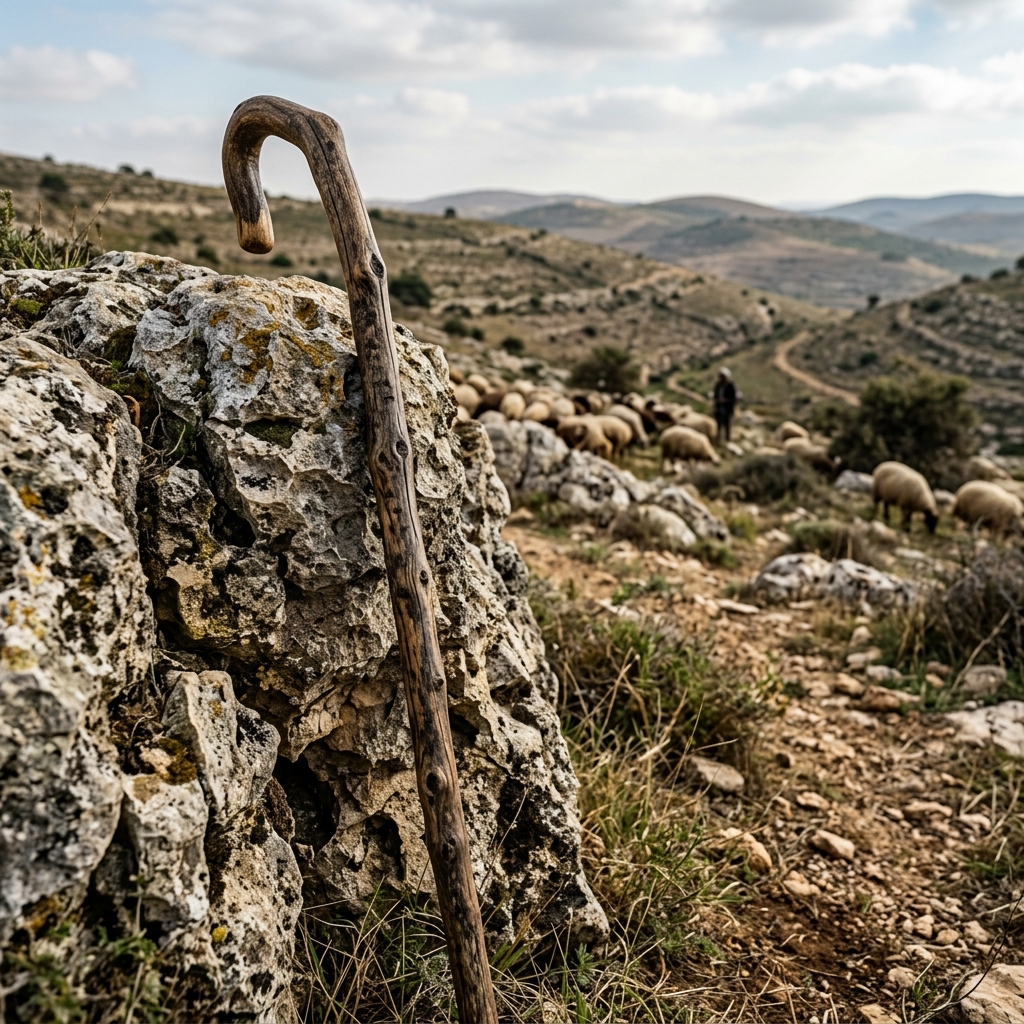
Illustration: reused existing 1 Samuel book artwork; it illustrates the pastoral setting rather than a historical portrait of David or Saul. No new image was generated for this study. The sequence graphic is HTML text and CSS for navigation and learning.